Supporting Material 1 (SM1) · 2026 AAUT Program Award

Evidence supporting the 2026 AAUT Program Award nomination

Structured AI-Guided Education (SAGE) Program · Dr Mahmoud Elkhodr and Professor Ergun Gide · CQUniversity Australia

SAGE is a six-step pedagogy that teaches students to begin from their own work, test AI output against authoritative disciplinary sources, decide what to accept, revise or reject, and defend the final reasoning as their own. It has been implemented at CQUniversity since Term 3 2022.

This page presents the primary and corroborating evidence supporting the nomination. The anchors SM1-A1 to SM1-D7 correspond to the claim identifiers used throughout the application.

New to SAGE? Start with the three-minute overview →

2,210unit enrolments across 13 CQUniversity units, representing 1,500+ individual students
2022–2026sustained classroom development, evaluation and refinement
12core empirical and conceptual SAGE studies mapped below
40+SAGE publications and related scholarly outputs in the broader research base
3TEQSA national resource listings, evidenced by archived pages
Reading rule

Each major claim is paired with its primary publication evidence and, where available, a separate record such as a result history, institutional guide, email, letter, media record or external case-study page.

Primary evidence — presented first

Core SAGE studies and what each one evidences

Each study is mapped to the claims, criteria and scholarly foundations it supports. S1–S12 are internal SM1 source identifiers used only on this evidence website; the nomination itself points assessors to the relevant SM1-A1 to SM1-D7 claim anchor.

SM1 sourceStudyDirect evidence contributionAAUT criteria and theory anchorsRecord
P0Framework paperSAGE framework paperM. Elkhodr and E. Gide, “Structured AI-guided education (SAGE): A six-step pedagogy for AI orchestration and assessment assurance in higher education,” STEM Education, vol. 6, no. 5, pp. 974–997, 2026. doi: 10.3934/steme.2026039.Canonical peer-reviewed account of the SAGE six-step pedagogy and its distributed Assurance by Design architecture.
Foundational framework
DOI ↗
S1ICT students’ perceptions towards ChatGPT: An experimental reflective lab analysisSTEM Education, 2023Origin study: student engagement and performance across three ICT case studies; identified over-reliance and the need for structured evaluation and reflection.
ACDConstructivismBloomSelf-regulation
DOI ↗
S2The role and impact of ChatGPT in educational practices: Insights from an Australian higher education case studyDiscover Education, 2024Cross-institutional transfer and student-rated benefit; demonstrates that the approach could move beyond its originating classroom and educators.
ABCDSituated learningDesign-based research
DOI ↗
S3The SAGE framework for developing critical thinking and responsible generative AI use in cybersecurity educationDiscover Education, 2025Cybersecurity cohorts evaluated AI advice against regulatory, organisational and professional constraints; evidence of critical thinking, completion and discipline-specific judgement.
ACDSituated learningConstructive alignmentEvaluative judgement
DOI ↗
S4AI leads, humans lead, or collaborate? Empirical findings and the SAGE roadmap for systems analysis and design educationSTEM Education, 2026Eighteen groups analysed from a cohort of 281 across five delivery contexts: selective AI orchestration, systematic error detection, context-sensitive rejection and accessibility improvement.
ACDSituated learningEvaluative judgementConstructive alignment
DOI ↗
S5From Permission to Pedagogy: The Structured AI-Guided Education Assessment Policy (SAGE-AP)Education Sciences, 2026Translates broad AI permission levels into task-level guidance on verification, declaration, student judgement and defensible authorship.
ACDAI literacyConstructive alignmentAssessment design
DOI ↗
S6Embedding assurance within learning: Empirical evidence from SAGE for repositioning take-home assessmentSTEM Education, 2026Audit evidence showed that only three of twenty-five process logs were substantially auditable; supports the shift from documentation policing to assurance embedded in learning.
ACDAssessment securityProgrammatic assessmentAssurance by design
DOI ↗
S7Eliciting Student Authority over AI Feedback: The AI as Critic Mechanism in SAGE-Based Systems Analysis and Design EducationTechnology, Knowledge and Learning, 2026, acceptedExamines how students accept, modify or reject AI critique and retain authority over the final disciplinary decision.
ACDSelf-regulationEvaluative judgementMetacognition
DOI ↗
S8How first-year students actually use ChatGPT in permitted assessmentsPreprint / submitted, 2026First-year cohort (n=167): 73% verified systematically and 81% revised deeply; engaging more iteratively was the most frequently selected intended change. The study identifies verification gaps and student demand for practical guidance.
ACDSelf-regulated learningMetacognitionAI literacy
Preprint ↗
S9Assurance by design: embedding the SAGE Defend step in AI-integrated higher education assessmentFrontiers in Education, vol. 11, art. 1872630, 2026Formalises discipline-matched Defend activities and fair, visible verification of student learning within AI-integrated assessment.
ACDAssessment securityProgrammatic assessmentConstructive alignment
DOI ↗
S10Supervising Research in the Age of Generative AI: The SAGE Research FrameworkUnder review, 2026Extends structured verification, disclosure, reflection and defensible authorship into research candidature and supervision.
ACDSelf-regulationResearch integrityEvaluative judgement
Under review
S11Promoting Critical AI Literacy in Transnational Computing Education Through a SAGE-Guided InterventionICAIES 2026, accepted and presentedUK–China Level 4 computing implementation: confidence rose from 2.84 to 3.63/5 and 57.3% correctly identified and justified an AI error.
ABCDSituated learningCritical AI literacy
Presented
S12Developing Critical AI Literacy through SAGE in Transnational Computing EducationUnder review, 2026Fuller account of the international intervention, disciplinary error-checking and transferability within a UK–China higher education programme.
ABCDSituated learningDesign-based research
Under review
Broader scholarly programme

GenAI in education — broader research base

The 12 studies above are the direct SAGE evidence. Together with the related outputs below, they form a 40+ publication research base spanning GenAI in education, AI literacy, assessment reform, curriculum design and interdisciplinary applications. This broader corpus demonstrates sustained scholarship; it does not replace the criterion-specific evidence.

12core SAGE studies mapped directly to the award criteria
40+publications and related scholarly outputs across the broader programme
100,000+collective views reported across the broader research corpus in the application
View 28 additional publications in the broader research corpus
  1. M. Elkhodr and E. Gide, Eds., Generative Artificial Intelligence Empowered Learning: A New Frontier in Educational Technology, 1st ed. New York, NY: Taylor and Francis, 2025, 248 pp. doi: 10.1201/9781003422433. eBook ISBN: 9781003422433
  2. R. Jamal Eddine, E. Gide, and A. Al-Sabbagh, "Generative AI in higher education: A cross-sector analysis of ChatGPT's impact on STEM, social sciences, and healthcare," STEM Education, vol. 5, no. 5, pp. 757–801, 2025. doi: 10.3934/steme.2025035
  3. K. Wangsa, S. Karim, E. Gide, and M. Elkhodr, "A systematic review and comprehensive analysis of pioneering AI chatbot models from education to healthcare: ChatGPT, Bard, Llama, Ernie and Grok," Future Internet, vol. 16, no. 7, art. 219, 2024. doi: 10.3390/fi16070219
  4. K. Wangsa, R. Sandu, S. Karim, M. Elkhodr, and E. Gide, "A systematic review and analysis on the potentials and challenges of GenAI chatbots in higher education," in Proc. 21st Int. Conf. Information Technology Based Higher Education and Training (ITHET), Paris, France, Nov. 2024, pp. 1–7. doi: 10.1109/ITHET61869.2024.10837608
  5. A. Al Tawara, J. El-Den, E. Gide, and Y. Sebastian, "A systematic review and comprehensive analysis of AI-enabled re-skilling and upskilling in education: Transformative strategies for the future," in Proc. 21st Int. Conf. Information Technology Based Higher Education and Training (ITHET), Paris, France, Nov. 2024, pp. 1–10. doi: 10.1109/ITHET61869.2024.10837638
  6. A. Al Tawara, E. Gide, and J. El-Den, "Systematic review and comprehensive analysis of integrating human-centered AI in higher education: Enhancing teaching, learning, and ethics," in Proc. 12th Int. Conf. Future Internet of Things and Cloud (FiCloud), Aug. 2025, pp. 305–312. doi: 10.1109/FiCloud61071.2025.00051
  7. H. Ranasinghe, E. Gide, and M. Elkhodr, "The significance of GenAI empowered ERP systems course teaching in quality education," in Proc. 21st Int. Conf. Information Technology Based Higher Education and Training (ITHET), Paris, France, Nov. 2024, pp. 1–7. doi: 10.1109/ITHET61869.2024.10837679
  8. G. Chaudhry, E. Gide, E. Yadegaridehkordi, and R. Tumpa, "Generative AI-powered teaching and learning in engineering and project management higher education: A systematic review," in Joint International Conference on AI, Big Data and Blockchain, Cham, Switzerland: Springer Nature, Aug. 2025, pp. 99–113.
  9. E. Gusman, E. Gide, M. Elkhodr, and G. Chaudhry, "The benefits and challenges of using artificial intelligence in teaching English as a foreign language in higher education," in Proc. 21st Int. Conf. Information Technology Based Higher Education and Training (ITHET), Paris, France, Nov. 2024, pp. 1–7. doi: 10.1109/ITHET61869.2024.10837597
  10. E. Gusman, E. Gide, G. Chaudhry, and M. Elkhodr, "A comprehensive review to identify the challenges and opportunities of using digital technology in English teaching in higher education," in International Society for Technology, Education, and Science, 2023.
  11. R. Sandu, E. Gide, S. Karim, and P. Singh, "A framework for GenAI-empowered curriculum and learning resources: A case study from an Australian higher education," in Proc. 21st Int. Conf. Information Technology Based Higher Education and Training (ITHET), Paris, France, Nov. 2024, pp. 1–8. doi: 10.1109/ITHET61869.2024.10837623
  12. N. Sandu and E. Gide, "Adoption of AI-Chatbots to enhance student learning experience in higher education in India," in Proc. 18th Int. Conf. Information Technology Based Higher Education and Training (ITHET), Sept. 2019, pp. 1–5. doi: 10.1109/ITHET46829.2019.8937382
  13. M. Elkhodr, K. Wangsa, E. Gide, and S. Karim, "A systematic review and multifaceted analysis of the integration of artificial intelligence and blockchain: Shaping the future of Australian higher education," Future Internet, vol. 16, no. 10, art. 378, 2024. doi: 10.3390/fi16100378
  14. M. Elkhodr, E. Gide, and N. Pandey, "Enhancing mental health support for international students: A digital framework for holistic well-being in higher education," STEM Education, vol. 4, no. 4, pp. 466–488, 2024. doi: 10.3934/steme.2024025
  15. N. Abbasi, E. Gide, P. Kalutara, and P. Lawrence, "Barriers and opportunities in online delivery of architecture and building design studios: Australian educators' perspectives," 2024. [Online]. Available: Architecture Science
  16. R. Jamal Eddine, E. Gide, and A. Al-Sabbagh, "Systematised evidence mapping of generative artificial intelligence (GenAI) and digital divide phenomena in higher education," Discover Computing, vol. 29, art. 157, 2026. doi: 10.1007/s10791-026-10044-w
  17. A. Azra, E. Gide, R. M. X. Wu, S. Karim, and R. Sandu, "Artificial Intelligence Enhancing Learning and Satisfaction in Higher Education," in CQU Scholarship of Tertiary Teaching Online Conference, Australia, 2020.
  18. A. M. Al Tawara, E. Gide, and M. El Khodr, "A Systematic Review and Framework for AI-Driven Transformation from E-Business to AI-Business in Australian SMEs," in Proc. 22nd Int. Conf. Information Technology Based Higher Education and Training (ITHET), May 2026.
  19. A. M. Al Tawara, E. Gide, and M. El Khodr, "Development of an AI-Business Transformation Framework for Australian SMEs: A PRISMA-Based Systematic Review and Design Science Approach," in Proc. 22nd Int. Conf. Information Technology Based Higher Education and Training (ITHET), May 2026.
  20. R. Agaloos, E. Gide, and M. ElKhodr, "An Analysis of GenAI Adoption Effectiveness in Philippines Healthcare SMEs," in Proc. 22nd Int. Conf. Information Technology Based Higher Education and Training (ITHET), Lilihammer, Norway, 2026, pp. 1–7. doi: 10.1109/ITHET69978.2026.11585098
  21. A. Al Tawara, E. Gide, and M. El Khodr, "Development of an AI-Business Transformation Framework for Australian SMEs: A PRISMA-Based Systematic Review and Design Science Approach," in Proc. 22nd Int. Conf. Information Technology Based Higher Education and Training (ITHET), Lilihammer, Norway, 2026, pp. 1–9. doi: 10.1109/ITHET69978.2026.11584989
  22. A. Al Tawara, E. Gide, and M. El Khodr, "A Systematic Review and Framework for AI-Driven Transformation from E-Business to AI-Business in Australian SMEs," in Proc. 22nd Int. Conf. Information Technology Based Higher Education and Training (ITHET), Lilihammer, Norway, 2026, pp. 1–8. doi: 10.1109/ITHET69978.2026.11585085
  23. R. Agaloos, E. Gide, and M. ElKhodr, "Investigating GenAI Adoption Readiness of Healthcare SMEs in Phillippines," in Proc. 22nd Int. Conf. Information Technology Based Higher Education and Training (ITHET), Lilihammer, Norway, 2026, pp. 1–7. doi: 10.1109/ITHET69978.2026.11584974
  24. H. Ranasinghe, E. Gide, and M. ElKhodr, "A Systematic Review of AI-ERP Integration for Educational Data Analytics and Institutional Insights," in Proc. 22nd Int. Conf. Information Technology Based Higher Education and Training (ITHET), Lilihammer, Norway, 2026, pp. 1–8. doi: 10.1109/ITHET69978.2026.11585168
  25. A. Azra, E. Gide, S. Karim, and M. ElKhodr, "A Comprehensive Analysis to Identify the Opportunities and Challenges of GenAI-Driven Research in Higher Education," in Proc. 22nd Int. Conf. Information Technology Based Higher Education and Training (ITHET), Lilihammer, Norway, 2026, pp. 1–10. doi: 10.1109/ITHET69978.2026.11585029
  26. H. Ranasinghe, E. Gide, and M. ElKhodr, "A Systematic Review of AI Applications in ERP Systems in Higher Education," in Proc. 22nd Int. Conf. Information Technology Based Higher Education and Training (ITHET), Lilihammer, Norway, 2026, pp. 1–9. doi: 10.1109/ITHET69978.2026.11585080
  27. S. Karim, E. Gide, A. Azra, M. Chowdhury, and R. Sandu, "The Impact of AI on the Quality of Learning and Teaching in Higher Education," in Proc. 22nd Int. Conf. Information Technology Based Higher Education and Training (ITHET), Lilihammer, Norway, 2026, pp. 1–5. doi: 10.1109/ITHET69978.2026.11585171
  28. A. Ul Hassan, G. Chaudhry, and E. Gide, "Using Generative AI to Educate and Train SMEs in Adopting Renewable Energy in Regional Australia," in Proc. 22nd Int. Conf. Information Technology Based Higher Education and Training (ITHET), Lilihammer, Norway, 2026, pp. 1–10. doi: 10.1109/ITHET69978.2026.11585089

Publications 1–12 are the core studies mapped above. The same full record is maintained on the SAGE publications page ↗.

Criterion A — publications plus direct student evidence

A. Positively impacted on student learning, student engagement or the overall student experience for a period of no less than three years

The empirical studies are the primary evidence. Dashboards, de-identified student decisions, result histories and independent educator observations show the underlying student behaviour and implementation context.

SM1-A1Sustained impact across levels, disciplines and delivery modes

Successive SAGE studies document progression from initial ICT classroom use to cybersecurity, systems analysis, first-year communication, research candidature and international technical tasks. Core SAGE was implemented across 13 CQUniversity units over ten teaching terms from Term 3 2022 to Term 2 2026, representing 2,210 unit enrolments and more than 1,500 individual students, together with cross-institutional and international implementations.

SM1 SAGE sources: S1, S2, S3, S4, S7, S8, S10, S11 and S12.
Implementation records: unit result histories for COIT20268, COIT12212, COIT20263 and COIT20248.
Evaluation cycle: observed student difficulty led to a documented program refinement in each phase.

SM1-A2First-year students learned to verify and revise rather than accept AI output

The n=167 first-year study records 73% systematic verification and 81% deeper revision; engaging more iteratively was the most frequently selected intended change (46.7%). Verification remained challenging, with 77.8% identifying accuracy checking as the hardest part, showing both active engagement and the continuing need for guided practice.

SM1 SAGE source: S8.
Interactive evidence: the public first-year dashboard presents the response distributions and learner profiles.
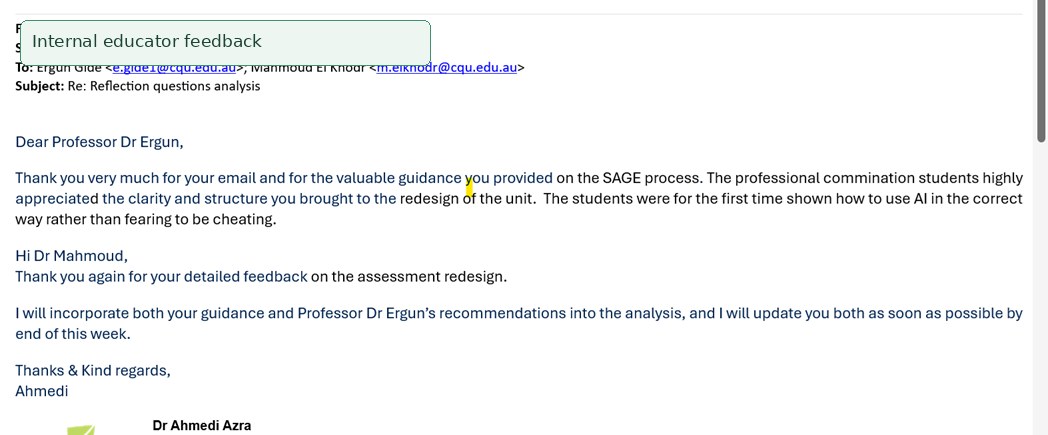
Independent corroboration: Dr Ahmedi Azra reported that students valued the clarity and structure and were taught appropriate AI use rather than approaching it mainly through fear of cheating.
Public translation (corroborating): PC1 and PC2 translate the student demand for practical guidance to higher-education audiences.

SM1-A3Advanced students demonstrated selective disciplinary judgement

Cybersecurity and systems-analysis students evaluated AI recommendations against regulatory, organisational, usability and task constraints. Strong acceptance of valid advice alongside rejection of contextually inappropriate advice indicates selective orchestration rather than indiscriminate compliance.

SM1 SAGE sources: S3, S4 and S7.
De-identified artefacts: the systems-analysis dataset records tests, AI recommendations, acceptance/rejection decisions and student reasons.
Corroboration: tutor feedback and an Atlassian engineering review of the authentic cybersecurity case.
Public translation (corroborating): PC9 reports the cybersecurity implementation for a wider science audience.

SM1-A4The learning model transferred beyond the originating classroom

The 2024 cross-institutional study included undergraduate and postgraduate students from business and ICT settings. The UK-China implementation then applied SAGE to a graph-theory problem in which students had to identify and justify an AI error.

SM1 SAGE sources: S2, S11 and S12.
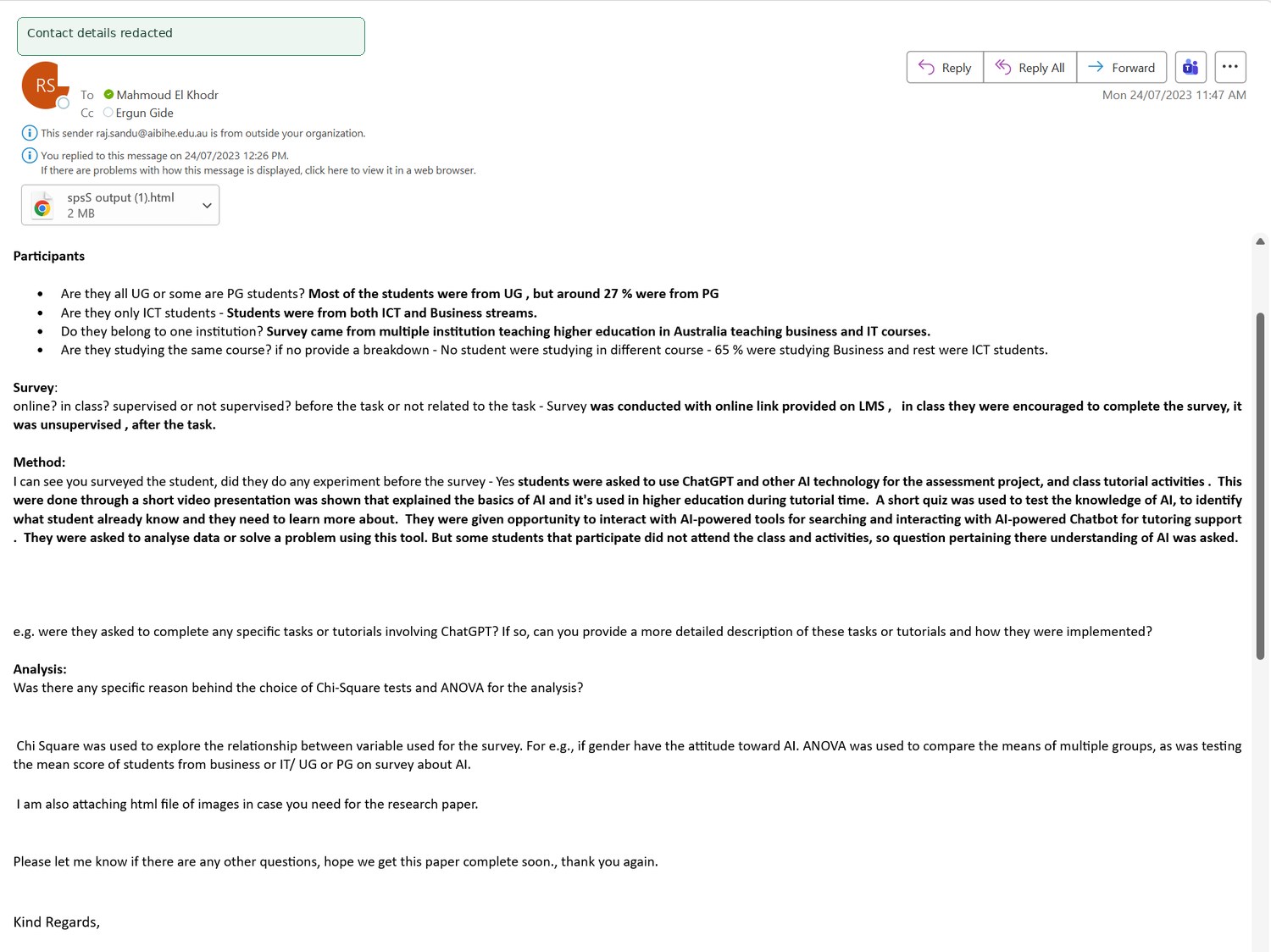
Australian implementation record: Dr Raj Sandu documented the multi-institution participant context and classroom/tutorial activities.
International outcome: confidence increased from 2.84 to 3.63/5 and 57.3% correctly identified and justified the technical error.

SM1-A5SAGE principles extended into research candidature

SAGE-R applies structured verification, reflection and defensible authorship to research supervision. The first graduate associated with this agenda completed a thesis rated by both examiners as outstanding quality and within the top 10% of the field.

SM1 SAGE source: S10.
Corroborating record: the Dean, School of Graduate Research congratulatory letter.
Careful interpretation: the record corroborates the graduate outcome; it does not attribute that outcome solely to SAGE.
First-year verification dashboard

Interactive evidence for the n=167 study, including verification, revision, challenge and learner-profile findings.

Open dashboard ↗
Systems-analysis decision dataset

De-identified group artefacts showing AI recommendations accepted, rejected or deferred with disciplinary reasons.

Open dataset ↗
Educator email reporting student appreciation of the clarity and structure of the SAGE redesign

Independent first-year educator observation

Students appreciated the redesign's clarity and structure and received practical guidance on appropriate AI use.

Cross-institutional implementation record describing participant groups and learning activities

Cross-institutional implementation record

Documents undergraduate/postgraduate, ICT/business and multi-institution participation behind S2.

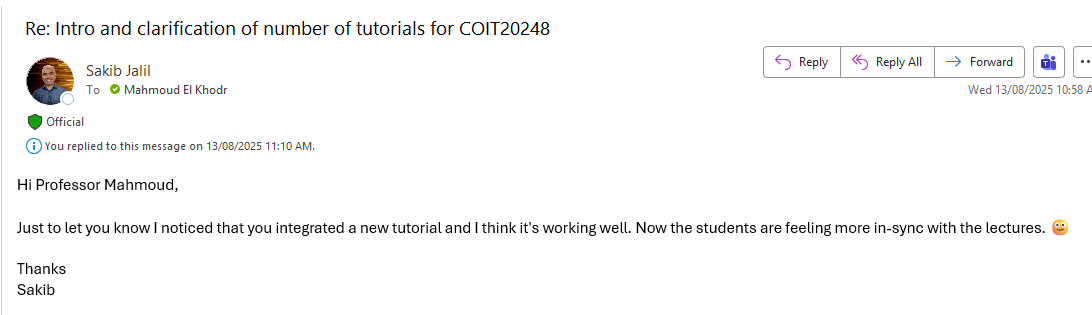
Tutor feedback reporting that the redesigned tutorial was working well

Independent tutor feedback

Corroborates improved alignment between tutorial activity and lectures in the systems-analysis redesign.

Criterion B — official adoption and independent recognition

B. Gained recognition from colleagues, the institution and/or the broader community

The evidence distinguishes formal institutional incorporation, national resource listing, independent educator uptake, cross-institutional implementation, international engagement and scholarly/public reach.

SM1-B1CQUniversity formally incorporated SAGE into its assessment model

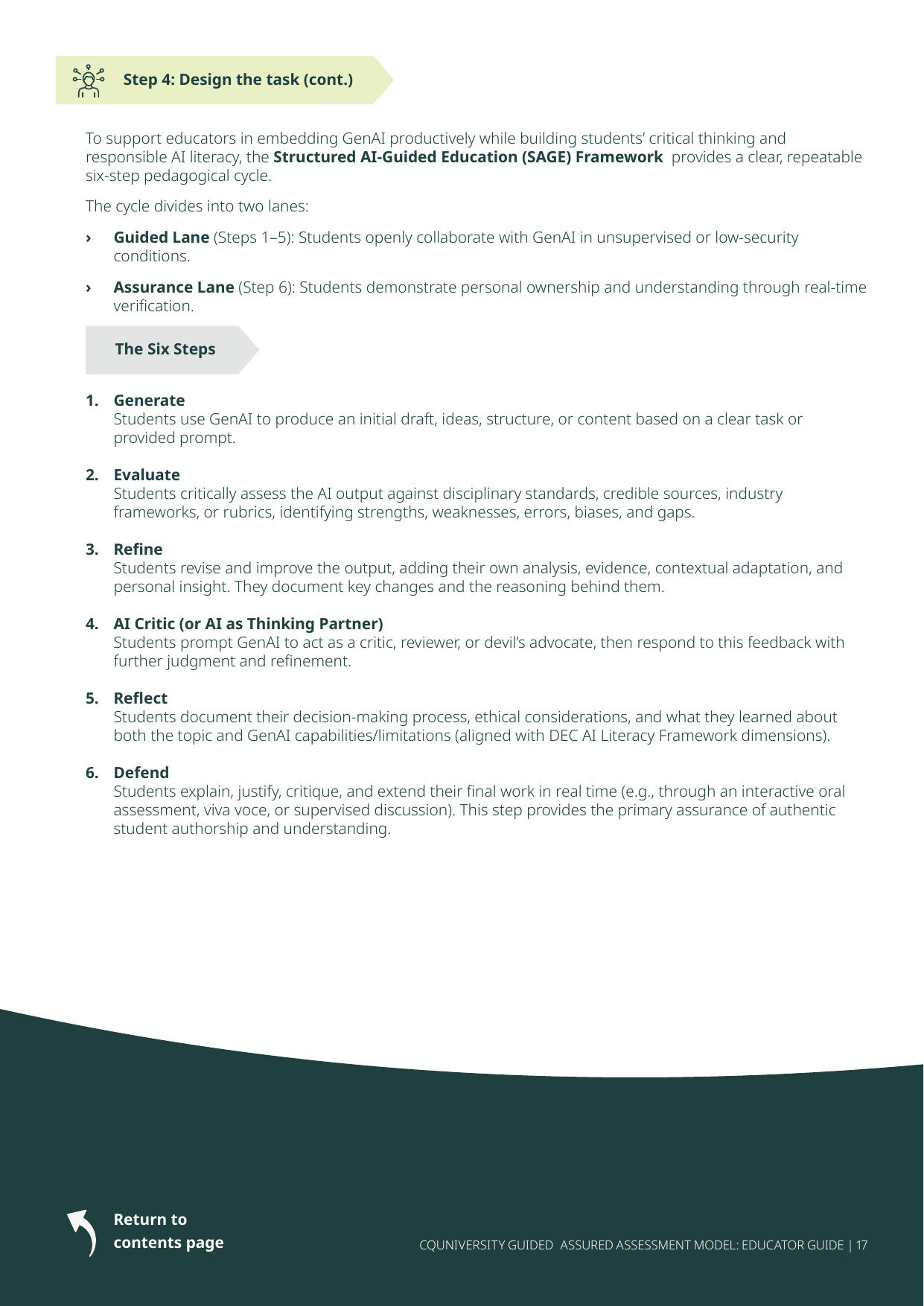
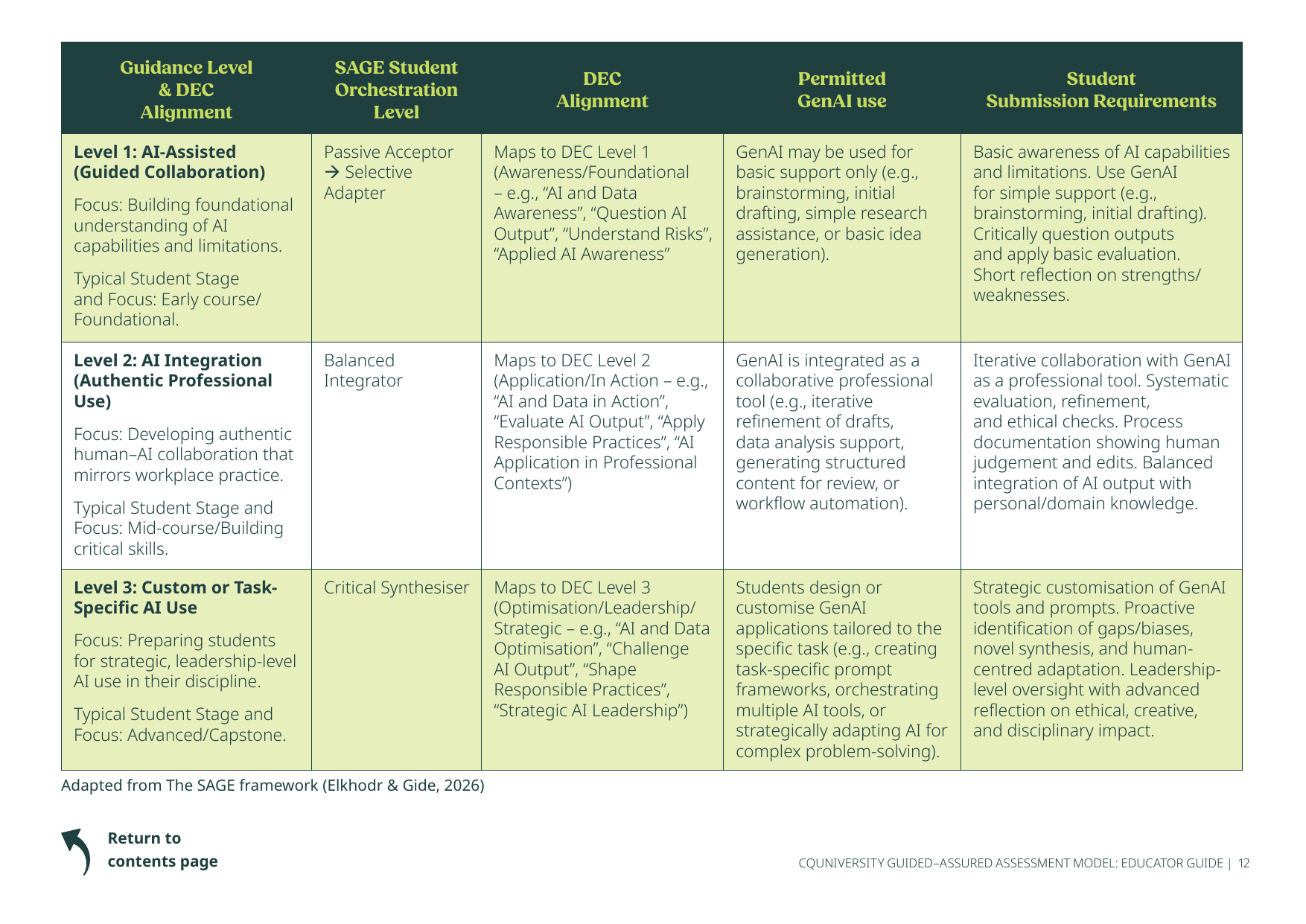
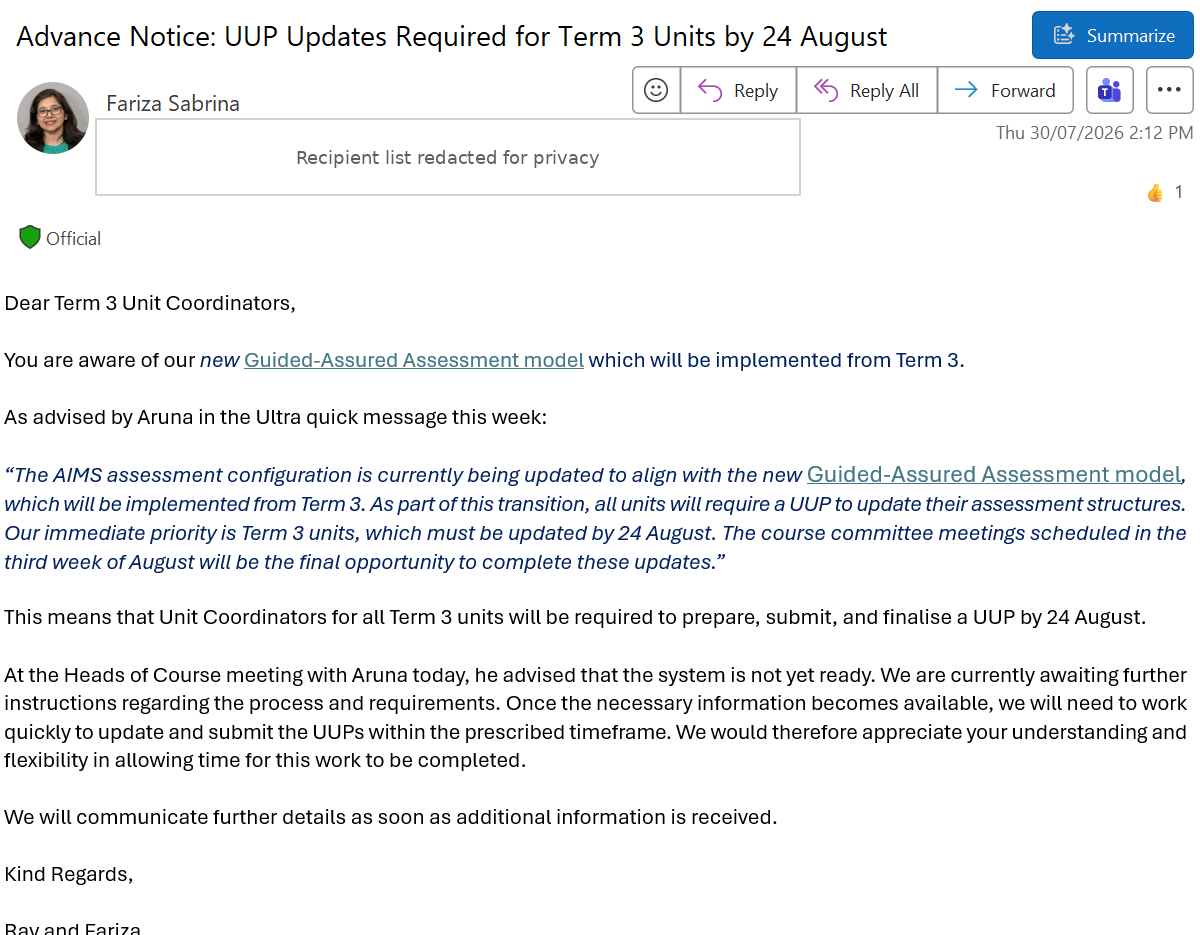
The evidence should be read as a sequence. The 2026 Guided-Assured Assessment Model Educator Guide first establishes SAGE inside the official model by naming the framework, reproducing its six-step cycle and mapping SAGE orchestration levels to university assessment guidance. A 30 July 2026 implementation notice then shows the Guided-Assured model moving into operational use across Term 3 unit-profile updates, while the Academic Learning Centre directly adopted the named SAGE GenAI-101 module in its student-facing GenAI resources. Together, these records demonstrate formal incorporation, operational rollout and central learning-support adoption.

2. Operational rollout, 30 July 2026: view the redacted Term 3 implementation notice ↗.
Careful interpretation: the rollout notice operationalises the Guided-Assured model across Term 3 units; it is not presented as proof that every unit must use SAGE specifically.

SM1-B2Educators outside ICT independently selected SAGE resources for their students

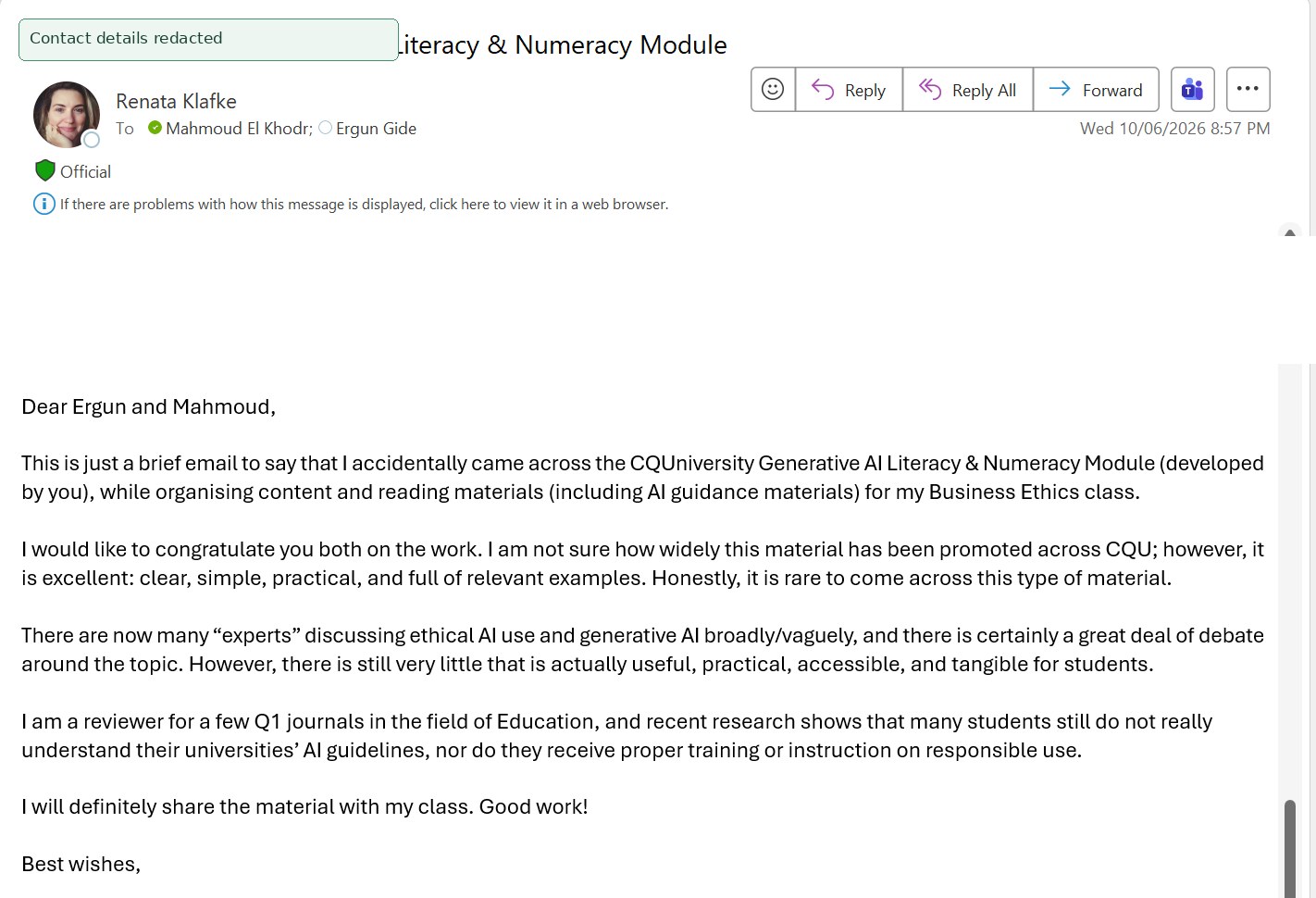
A Business Ethics lecturer independently discovered the Generative AI Literacy and Numeracy Module, described it as clear, practical, accessible and tangible for students, and committed to sharing it with her class.

Evidence: view the redacted email from Dr Renata Klafke ↗, School of Business and Law.
Value: cross-disciplinary recognition and intended uptake without mandate or direct promotion.
Careful wording: evidence of committed uptake; completed student outcomes are not claimed.

SM1-B3Three SAGE resources received national TEQSA listing

Archived TEQSA pages show the implementation guide under Academic integrity and assessment reform, and the literacy/numeracy module and first-year student-use resource under Student resources and support.

Evidence: three separate national resource entries.
Supporting resources: S5, S8 and the evidence-based implementation guide.
Careful wording: national recognition and resource listing, not national adoption.
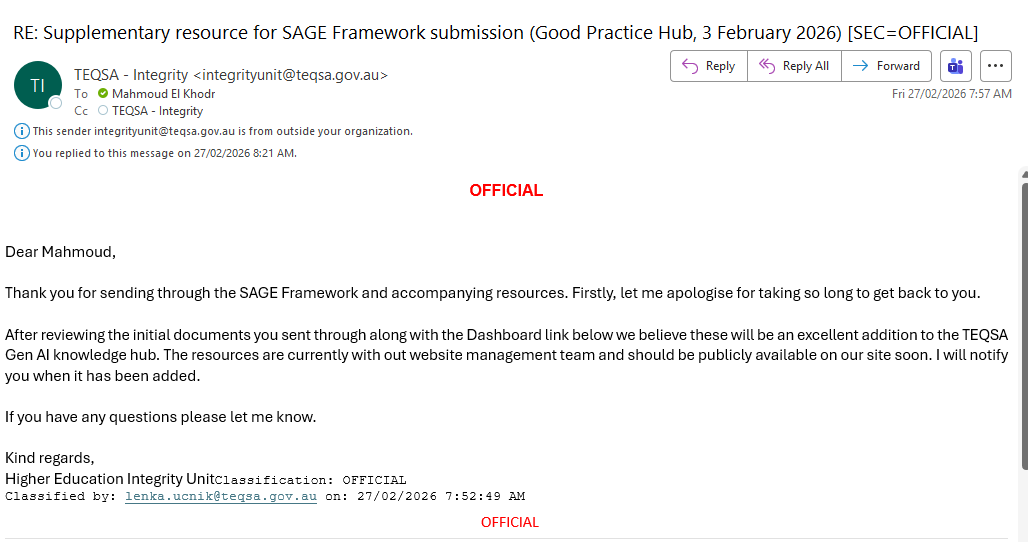
Official TEQSA Higher Education Integrity Unit email dated 27 February 2026 endorsing the SAGE Framework and resources for inclusion in the Gen AI Knowledge Hub.

TEQSA review and endorsement

On 27 February 2026, after reviewing the SAGE Framework, accompanying resources and dashboard, TEQSA’s Higher Education Integrity Unit advised that the resources would be “an excellent addition to the TEQSA Gen AI Knowledge Hub”. The resources were subsequently published through three separate national Hub listings.

Source: TEQSA Higher Education Integrity Unit official email, 27 February 2026.

SM1-B4External academics initiated and implemented cross-institutional work

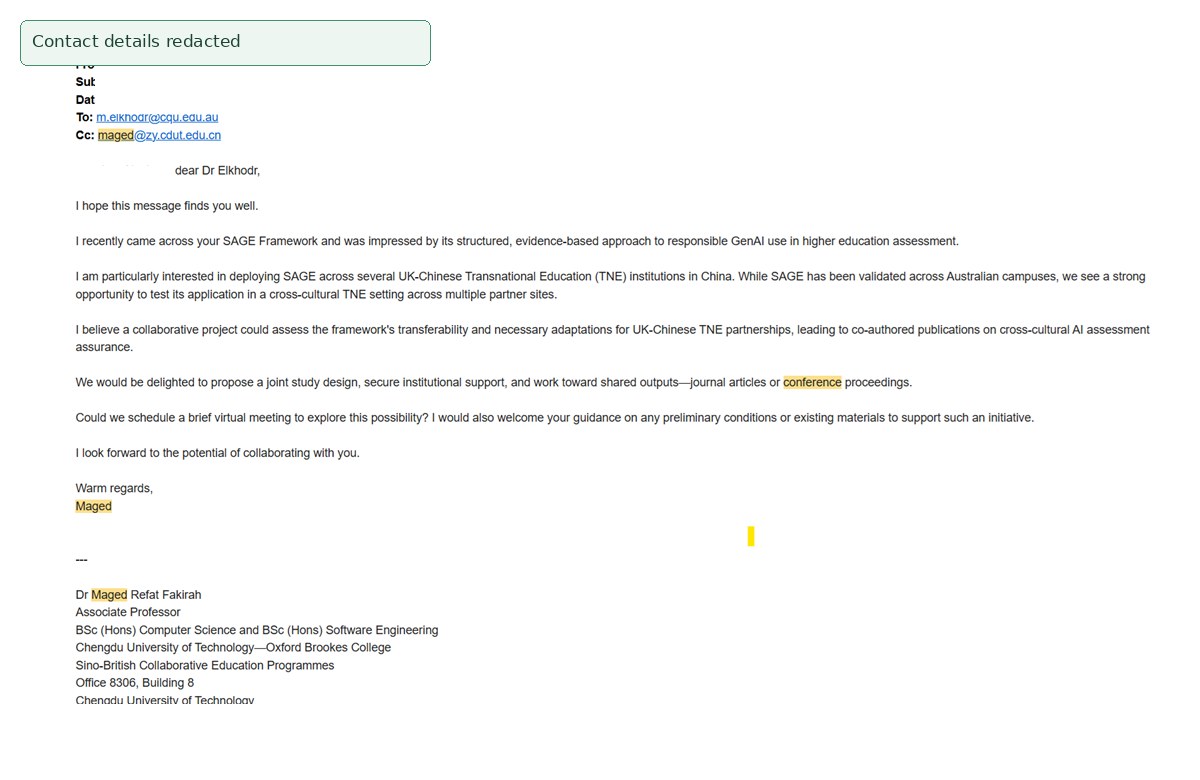
Dr Raj Sandu's record supports the Australian cross-institutional study. Associate Professor Maged Fakirah independently approached the team after identifying SAGE as a structured, evidence-based framework suitable for UK-Chinese transnational education, leading to the documented technical implementation and accepted conference work.

Australian evidence: S2 and implementation email.
International evidence: S11 and S12, initial unsolicited approach and support/grant letter.
Independent recognition: University of Warwick Education Portal case study.

SM1-B5The research and resources show substantial scholarly and practitioner reach

Dated publisher, Google Scholar and Zenodo records provide transparent evidence of readership, citation and resource uptake. Platform-specific metrics are labelled rather than combined as if they were directly equivalent.

Selected publisher reach: view the dated records for the 2023 ICT study, 2024 cross-institutional study and systematic review ↗.
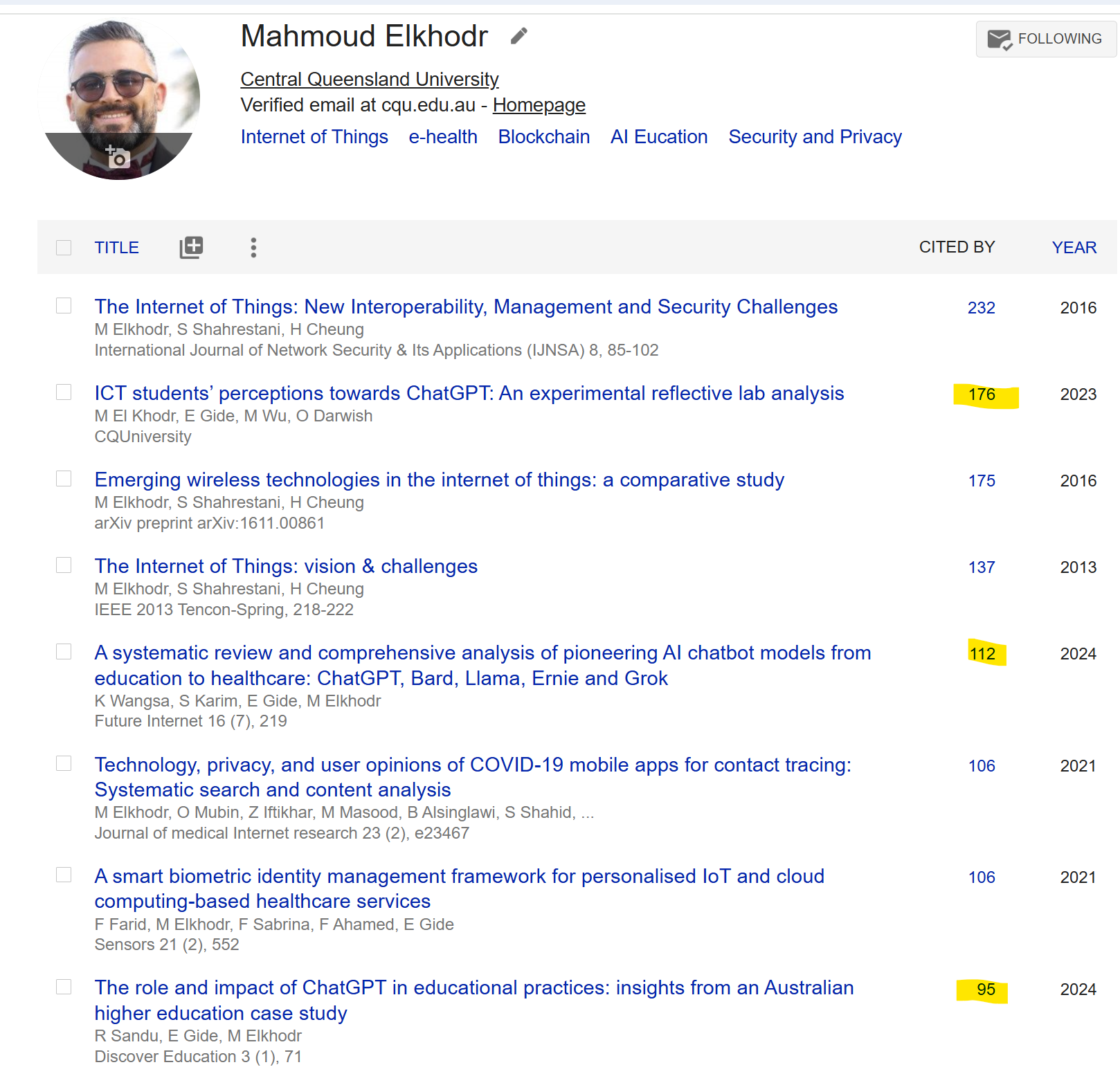
Selected Google Scholar records: open the Google Scholar publication profile ↗.
Public and sector commentary: PC1, PC2, PC3, PC4, PC5, PC6, PC8 and PC9 translate the research for sector and community audiences.
CQUniversity Guided-Assured Assessment Model page 17 naming SAGE and presenting its six steps

Official CQUniversity adoption: six-step cycle

Page 17 names SAGE and incorporates Generate, Evaluate, Refine, AI Critic, Reflect and Defend.

CQUniversity guide page 12 mapping SAGE student orchestration levels

Official CQUniversity adoption: orchestration levels

Page 12 maps SAGE Student Orchestration Levels to guidance, permitted use and student submission requirements.

Redacted 30 July 2026 CQUniversity notice stating that the Guided-Assured Assessment Model will be implemented from Term 3 and requires unit-profile updates

Operational rollout of the Guided-Assured model

On 30 July 2026, Term 3 Unit Coordinators were advised that the Guided-Assured Assessment Model would be implemented from Term 3 and that assessment structures must be updated through the University Unit Profile process. Read after the official guide above, this shows the institutional mechanism through which SAGE-informed guided-assurance practice can move into operational use.

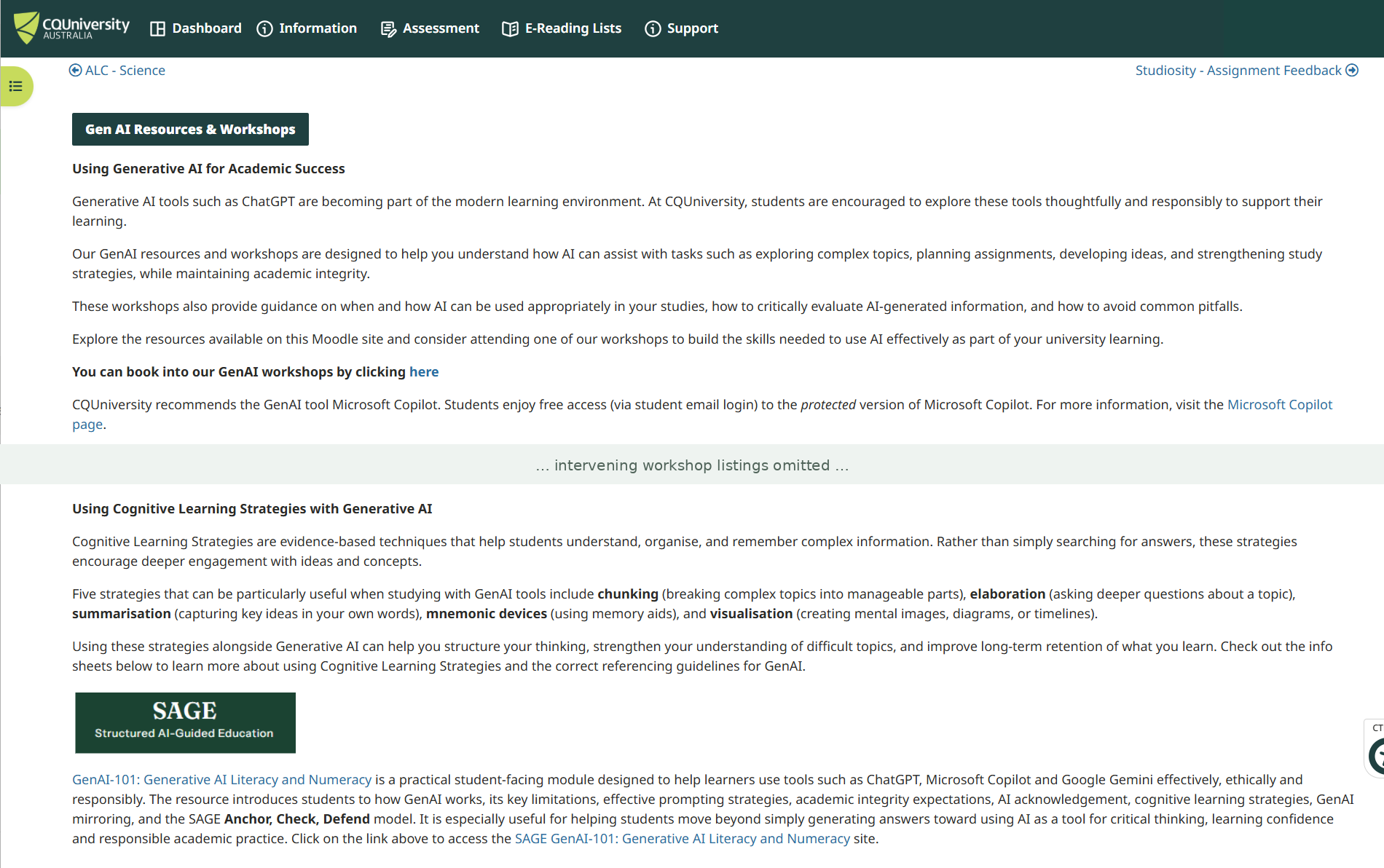
CQUniversity Academic Learning Centre student-facing GenAI resources page incorporating the SAGE GenAI-101 Generative AI Literacy and Numeracy module

Direct Academic Learning Centre adoption

CQUniversity’s Academic Learning Centre incorporated the SAGE GenAI-101: Generative AI Literacy and Numeracy module into its student-facing GenAI Resources and Workshops site, extending SAGE beyond individual units into central academic-learning support.

Business Ethics lecturer email praising and committing to share the SAGE literacy and numeracy module

Independent cross-disciplinary uptake

Unsolicited recognition from a Business Ethics lecturer outside ICT.

Unsolicited international email proposing UK-Chinese transnational implementation of SAGE

Unsolicited international approach

Initial external contact proposing SAGE deployment and transferability testing in UK-Chinese TNE contexts.

16,641publisher-recorded views for the 2023 ICT study, plus 922 PDF downloads
16kpublisher-recorded accesses for the 2024 cross-institutional study
18,676publisher-recorded views for the systematic review
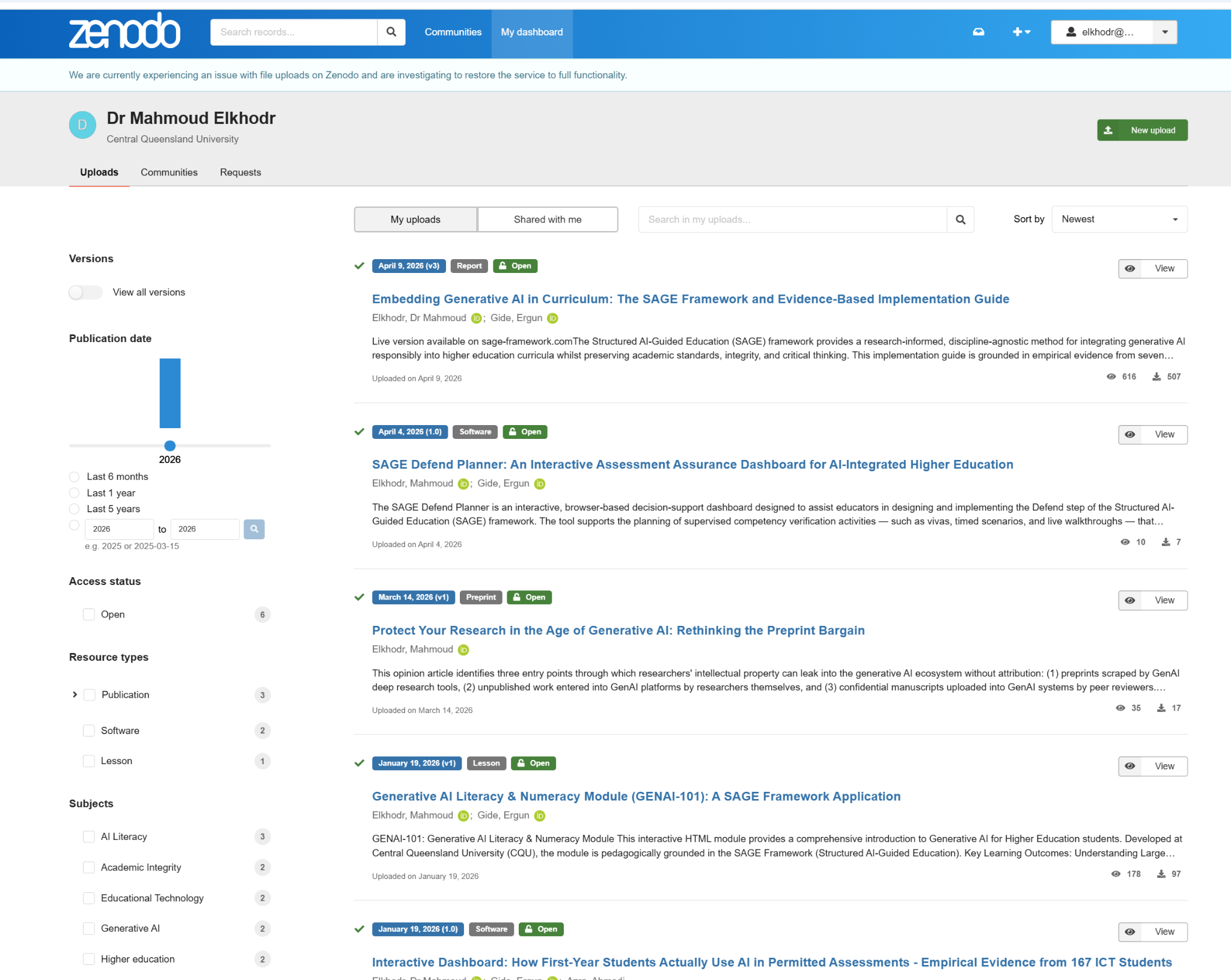
507downloads of version 3 of the SAGE implementation guide, from 616 views
Google Scholar screenshot showing selected citation counts

Selected Google Scholar citation counts

176 citations for the origin study, 112 for the systematic review and 95 for the cross-institutional case study at capture.

Zenodo screenshot showing version 3 implementation guide views and downloads

Open-resource uptake

Version 3 of the implementation guide recorded 616 views and 507 downloads, alongside use of related SAGE tools.

Publisher metrics and Google Scholar counts use different databases and are therefore displayed separately. The values are dated evidence snapshots and should be refreshed shortly before submission.

Corroborating public translation

Public & sector commentary

These numbered sources show how SAGE research and its implications have been translated for higher-education, professional and community audiences. They evidence dissemination, reach and sector engagement; the primary evidence remains the peer-reviewed studies and implementation records above.

References PC1–PC10 are used throughout Criteria A–D as corroborating translation and reach evidence.

Criterion C — innovation evidenced through use and adoption

C. Shown creativity, imagination and/or innovation

The innovation is not the existence of six labels. It is the integration of guided AI use, disciplinary judgement and direct assurance within one adaptable learning-and-assessment architecture.

SM1-C1A six-step architecture joins learning with assurance

Generate, Evaluate, Refine, AI Critic and Reflect develop capability in open conditions; Defend provides a discipline-appropriate check of individual understanding. The architecture has moved from empirical classroom design into CQUniversity's official assessment guidance.

SM1 SAGE sources: S1, S3, S4 and S9.
Official incorporation: CQUniversity Guided-Assured Assessment Model, page 17.
Novel contribution: guidance and assurance are designed as a connected sequence rather than separate policy and policing activities.
Public translation (corroborating): PC4 and PC6 explain the architecture's focus on critical thinking and visible student judgement.

SM1-C2AI Critic makes student authority visible

Students ask AI to critique their work and then judge the critique. They must accept, reject or modify advice with reasons, making authority calibration and evaluative judgement visible.

SM1 SAGE sources: S4 and S7.
Direct artefacts: the systems-analysis dataset records decisions and reasons.
Theory: evaluative judgement, metacognition and self-regulated learning.

SM1-C3Assurance by design replaces unreliable retrospective proof

After the process-log audit found only three of twenty-five submissions substantially auditable, the program shifted toward task-matched Defend activities and articulated assurance debt and assurance by design.

SM1 SAGE sources: S6 and S9.
Supporting tool: SAGE Defend Planner.
Student benefit: ownership is demonstrated through the learning activity rather than inferred from a final artefact or potentially unreliable log.
Sector debate: PC3 positions assurance by design against defaulting to low-tech examinations.

SM1-C4SAGE developed into an integrated, portable program

SAGE Pedagogy develops student judgement; SAGE-AP converts permission into assessment requirements; SAGE-R extends responsible authorship into research; and SAGE-I is the planned workplace translation. The core is adapted to disciplinary evidence and defence formats rather than copied rigidly.

SAGE Pedagogy: S1, S2, S3, S4, S7 and S8.
SAGE-AP and Defend: S5, S6 and S9.
SAGE-R: S10 and graduate evidence. SAGE-I: retained as emerging/pending evidence.

SM1-C5Authenticity was tested against professional practice

The Head of Engineering at Atlassian reviewed the cybersecurity assessment case and confirmed alignment with contemporary industry risks, challenges and opportunities, supporting the authenticity of the context in which students judged AI advice.

SM1 SAGE source: S3.
Independent corroboration: redacted industry review.
Value: validates the professional context, not merely the novelty of the pedagogy.
See AI judgement in student artefacts

The public dataset shows recommendations, decisions and reasons rather than only reporting summary percentages.

Open systems-analysis evidence ↗
Design assurance activities

The SAGE Defend Planner translates the innovation into practical assessment design choices.

Open Defend Planner ↗
Criterion D — theory mapped to decisions and studies

D. Drawn on the scholarly literature on teaching and learning to inform the development of initiatives, programs and/or practice

The nomination cites the independent scholarly foundations directly. This SM1 mapping shows how those foundations informed specific SAGE design decisions and where the resulting practices were evaluated or formalised across the programme. S1–S12 are supporting SAGE sources within SM1 rather than nomination reference numbers.

Constructivism and revised Bloom’s taxonomySM1-D1

Students begin with a draft or problem representation, then analyse, evaluate, revise and defend rather than submit AI output as an answer.

Mapped studies: S1, S2, S3, S4 and S7. Programme decision: progression from Generate to Evaluate, Refine and Defend.

Situated learningSM1-D2

AI output is judged against the standards, constraints and practices of the student’s discipline rather than generic accuracy alone.

Mapped studies: S3, S4, S11 and S12. Programme decision: cybersecurity frameworks, organisational constraints and mathematical optimisation principles become evidence anchors.

Self-regulated learning and metacognitionSM1-D3

Students monitor their reliance on AI, explain changes, reflect on weaknesses and plan a more effective subsequent attempt.

Mapped studies: S1, S7, S8 and S10. Programme decision: explicit reflection, iteration and disclosure of accepted, modified and rejected output.

Constructive alignmentSM1-D4

AI conditions, learning activities, disciplinary evidence and the method of assurance are aligned with the intended learning outcomes.

Mapped studies: S3, S4, S5, S6 and S9. Programme decision: task-level guidance and discipline-matched Defend activities.

Assessment security and programmatic assessmentSM1-D5

Assurance is accumulated through appropriate checks across learning rather than concentrated in one final examination or inferred from process logs.

Mapped studies: S6 and S9. Programme decision: assurance by design and management of assurance debt.

Evaluative judgement and AI literacySM1-D6

Students learn to judge the quality, relevance and consequences of AI output and to retain authority over the final decision.

Mapped studies: S3, S4, S5, S6, S7, S8, S9, S11 and S12. Programme decision: AI Critic, evidence anchoring and reasoned acceptance/rejection.

Design-based researchSM1-D7

Each implementation identified a student problem, introduced a change, collected classroom evidence and informed the next iteration.

Mapped studies: S1, S2, S3, S4, S5, S6, S7, S8, S9, S10, S11 and S12. Programme decision: a cumulative programme evolving from classroom pedagogy to SAGE-AP, Defend, SAGE-R and international adaptation.

How to read the mapping: these are best-fit theory anchors across a cumulative research programme. The empirical papers commonly draw on several foundations; the mapping is intended to show how scholarship informed specific design decisions, not to force each paper into a single theory.
Public translation: PC1, PC2, PC3 and PC10 carry the scholarly reasoning into assessment-policy, research-integrity and sector-practice discussions.
Evidence archive

Documents and dated screenshots used on this page

The main page shows only the strongest evidence. The archive below provides the complete supporting trail without crowding the criterion sections.

Institutional adoption and national recognition

Official CQUniversity guide, staff-development email and TEQSA resource listings.

Student impact and implementation records
Independent, international, research and industry corroboration

Cross-disciplinary uptake, international approach/support, external case study, graduate outcome and industry review.

Scholarly reach and open-resource uptake
Practice publications and media records

Sector-facing translation and public communication already catalogued on the main publication page.

Supporting Material 2 (SM2) · Program synthesis

Three-minute SAGE Program Overview

This three-minute video provides a concise overview of the program’s development, student impact and wider adoption. The detailed evidence supporting these claims is presented throughout this page.

Duration: 2 minutes 58 seconds. The video is embedded here for convenience and is also available as a standalone supporting material: open SM2 directly ↗. The publications and documentary records on SM1 remain the detailed evidence base.

Evidence trail

From classroom evidence to an integrated programme

The core studies show how successive student findings shaped the programme. The records on this page corroborate institutional uptake, national recognition, international transfer, professional relevance and sustained implementation.