SAGE-R · Structured AI-Guided Education for Research
From AI assistance to research ownership.
SAGE-R extends the SAGE framework into higher degree research. It is organised in three stages: candidates Use AI with default ownership of all their work, Own any claim that AI assistance has changed before relying on it, and Defend consequential claims in a supervisory discussion held at a milestone that already exists.
Designed to fit existing candidature milestones. No AI detection and no new forms are required.
AI can help with research. It can also change what the research says.
Research candidates now use AI for many tasks, such as finding papers, tidying writing, fixing code and summarising data. Most of this help leaves the research itself untouched: the question, the evidence, the method, the findings and what they mean are still the candidate’s.
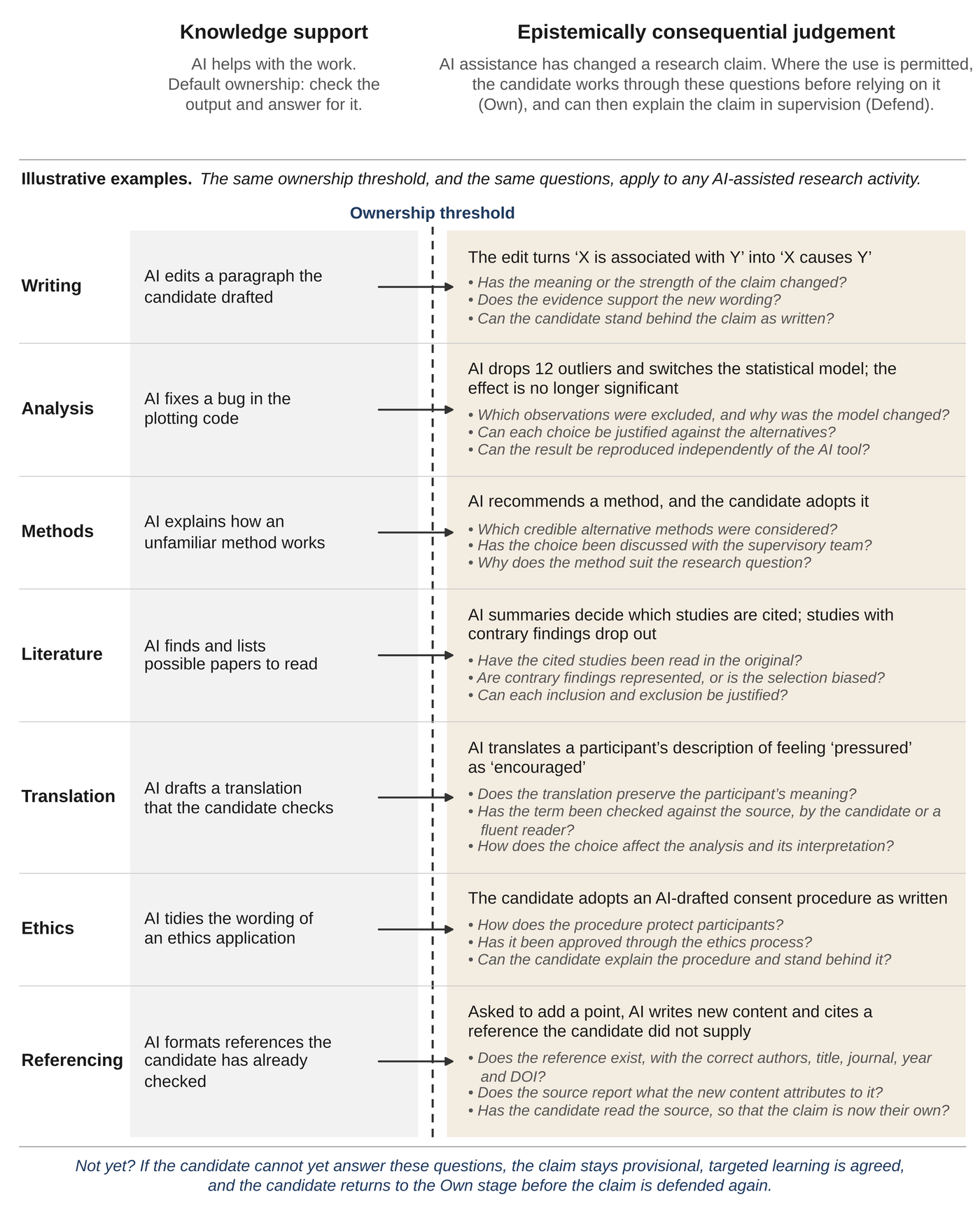
Sometimes AI does more than help. An edit turns “is associated with” into “causes”. A tool quietly drops data points and the result changes. A summary decides which studies are cited and which are left out. In each case AI has changed what the research claims, often without anyone noticing.
AI helps with the work
The research claims are unchanged- Finds and lists papers to read
- Fixes a bug in plotting code
- Tidies the wording of a paragraph
- Formats references already checked
- Explains how an unfamiliar method works
- Drafts a translation that the candidate checks
AI changes a claim
What the research says is now different- Decides which studies are cited
- Drops outliers and switches the statistical model
- Turns an association into a cause
- Adds content and a reference the candidate did not supply
- Recommends a method that the candidate adopts without weighing the alternatives
- Changes a load assumption in a simulation unnoticed, and the design now passes its safety check
SAGE-R is built on this difference. Help with the work is treated as ordinary research practice, and the candidate is responsible for it as for anything else. A claim that AI has changed needs more: before it is relied upon, the candidate must make it their own, be able to defend it, and stand behind it by taking responsibility for it. The boundary between using AI in an assistive manner (knowledge support) and using AI in a way that shapes what the research claims (epistemically consequential judgement) is referred to as the ownership threshold. Reaching it is normal: it means more care is needed, not that the use is improper.
Two kinds of ownership
Classifying an activity as knowledge support does not mean that it goes unchecked. The candidate is still responsible for it: AI outputs are read and checked before they are used, errors are corrected, and every part of the work can be answered for. In SAGE-R this is called default ownership.
Where AI changes a claim, default ownership is not enough. Extra care is needed, and a greater responsibility is carried, before the claim is relied upon. In SAGE-R this is called accountable epistemic ownership.
Default ownership
Being responsible for all of the work, whatever tools helped.
- AI outputs are checked before they are used.
- Errors are found and corrected.
- Every part of the work can be answered for.
- “The AI did it” is never an answer.
Accountable epistemic ownership
Making a changed claim genuinely the candidate’s own before it is relied upon.
- What AI changed is understood, and the sources are read.
- Results, sources and meaning are checked.
- Alternatives, consequences, bias and ethics are weighed.
- The claim can be explained, justified, verified and stood behind.
Use, Own, Defend
Use applies to every kind of AI assistance and carries default ownership. Own and Defend are added only where a claim has changed: accountable epistemic ownership is built first by the candidate and then shown in a supervisory discussion that is already part of candidature.
- UseCandidate · every AI-assisted task
AI is used, where permitted, as knowledge support for searching, drafting, coding or formatting. Default ownership applies throughout: the candidate checks the output and answers for it, and “the AI did it” is never an answer.
- OwnCandidate · when a claim has changed
Before a changed claim is relied upon, the candidate makes it their own. What AI changed is understood and the sources are read. Results, sources and meaning are checked. Alternatives, consequences, bias and ethics are weighed before the claim is accepted, revised or rejected, and the reasons are recorded.
- DefendCandidate with supervisor · at an existing milestone
At a progress review, confirmation of candidature or research-group presentation, the candidate explains, justifies, verifies and stands behind the claim. A claim that cannot yet be defended stays provisional while the candidate returns to Own.
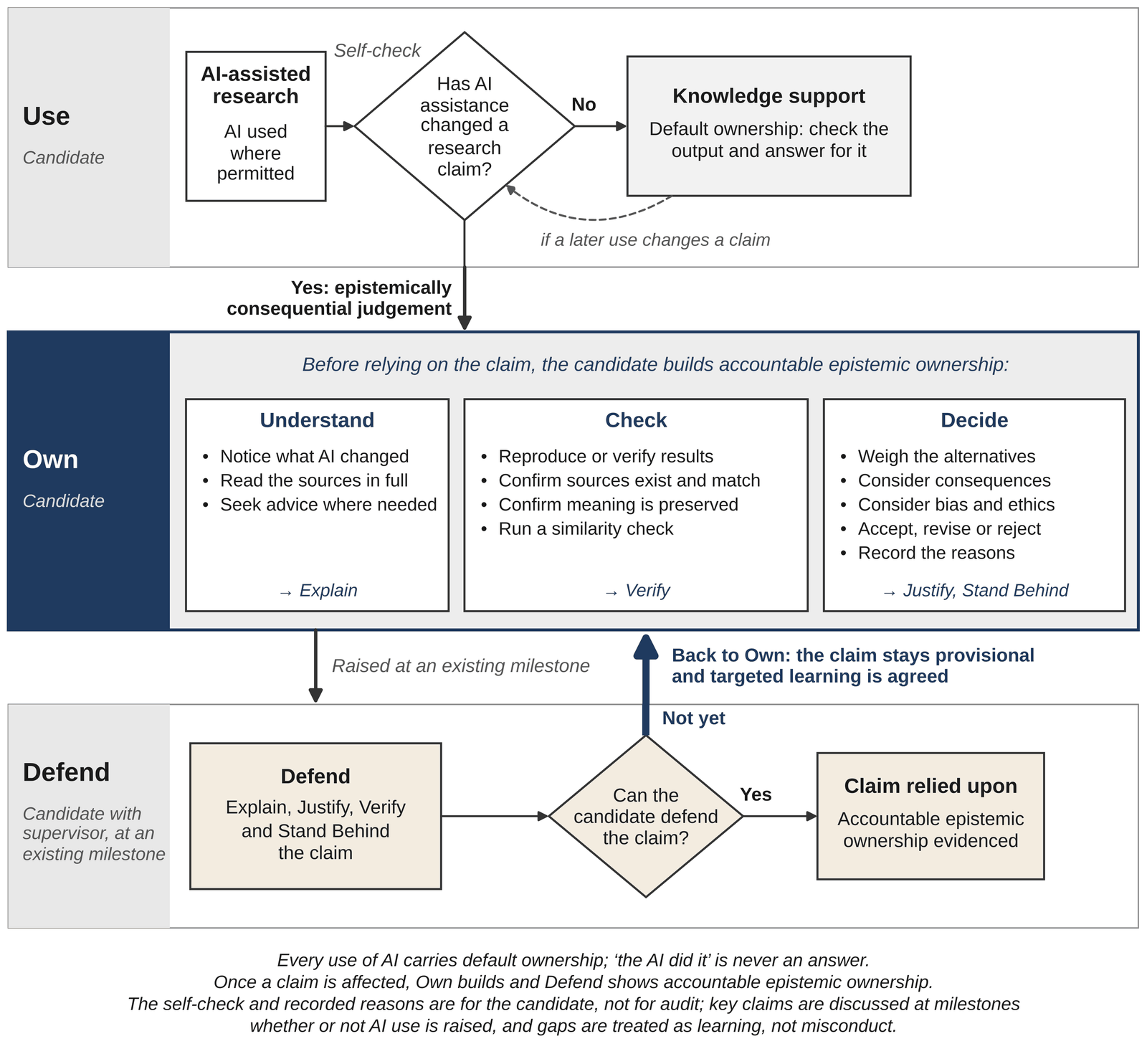
The candidate owns all of the work. Own and Defend are added only where AI assistance has changed a research claim.
Telling help from a changed claim
The ownership threshold between help with the work and a changed claim is not always obvious, and the same activity can fall on either side. It is decided by a single self-check, which supervisors model early in candidature and which is revisited whenever a later use of AI changes a claim.
Has AI assistance changed a research claim?
- ContributionCould the AI assistance have altered what this part of the research contributes?
- ConsequenceWould an unnoticed error have material consequences for the findings?
- Independent verificationCan the output be verified independently of the AI tool?
The questions concern the claim, not the candidate. Where they point to a changed claim, the work moves to Own.
If you use AI, you remain responsible and must stand behind the research.
Six actions apply whenever AI assists the research. Actions 1 to 3 belong to Use, actions 4 and 5 to Own, and action 6 to Defend.
- 01
Check permission Use
Is this use permitted by your institution, ethics approval, funder or publisher?
- 02
Protect the research Use
Keep confidential data and unpublished work out of unapproved tools.
- 03
Set the boundary Use
Decide what AI may help with and what judgement stays yours.
- 04
Verify independently Own
Check against original sources, data, code, methods or other evidence.
- 05
Record and disclose Own
Follow the record-keeping and disclosure requirements that apply to your research.
- 06
Defend the work Defend
Explain, justify, verify and stand behind your decisions and claims.
At the centre of the cycle: you own the research, including its decisions, evidence and claims.
If you cannot yet explain, justify, verify and stand behind a claim, it is not yet ready to enter the research.
Defend
A supervisory discussion at a milestone that already exists.
“Why did you choose this method, and how did you check what the AI produced?”
An illustrative question in a supervisory meeting
What did you do, and how did AI contribute?
Why was this approach appropriate?
What evidence beyond AI checks the result?
Can you take responsibility for the claim?
Defend is held at a milestone that already exists, such as a progress review, confirmation of candidature or a research-group presentation. It concentrates on claims that AI assistance has changed and is proportionate to their consequence. Key claims are discussed whether or not AI use is raised. Where a claim cannot yet be defended, the outcome is not yet: the claim stays provisional, targeted learning is agreed, and the candidate returns to Own. Incomplete understanding on its own is a matter for learning, not misconduct; a gap that remains unresolved over time is considered under existing progression processes, and evidence of a possible integrity breach under the appropriate procedure. Required disclosure of AI use continues to apply.
Taking SAGE-R into institutional guidance
SAGE-R is designed to be adopted within existing guidance rather than alongside it. Assurance is planned from the start of candidature and distributed across milestones that already exist, from the research proposal to thesis submission, so that ownership is supported as decisions are made rather than examined only at the thesis.
- A shared vocabularyDefault ownership, knowledge support and epistemically consequential judgement give candidates, supervisors and panels common terms for discussing AI use.
- Three guiding questionsContribution, consequence and independent verification provide a proportionate basis for deciding when a claim needs more than default ownership.
- Own work by the candidateUnderstanding, checking and deciding are carried out by the candidate before a changed claim is relied upon. The recorded reasons support the candidate’s scholarship rather than an audit.
- Defend at existing milestonesSupervisory discussion at development planning, confirmation of candidature, progress reviews and pre-submission makes ownership visible without an additional assessment event.
SAGE-R does not rely on AI detection or the monitoring of writing style, and it introduces no new forms. Similarity checking for plagiarism continues as usual, and required disclosure of AI use continues to apply.
M. Elkhodr and E. Gide, “Supervising AI-mediated research: the SAGE-R framework for accountable research ownership,” Frontiers in Education, vol. 11, Art. no. 2030368, 2026, doi: 10.3389/feduc.2026.2030368.