Practical guidance for using permitted AI in your research while keeping every claim your own.
Based on the SAGE-R framework (Elkhodr and Gide, 2026) · Updated November 2026 Dr Mahmoud Elkhodr & Professor Ergun Gide · CQUniversity Australia
Part1
The framework
What SAGE-R asks of you, and how to tell help with the work from a changed claim.
Use, Own, Defend
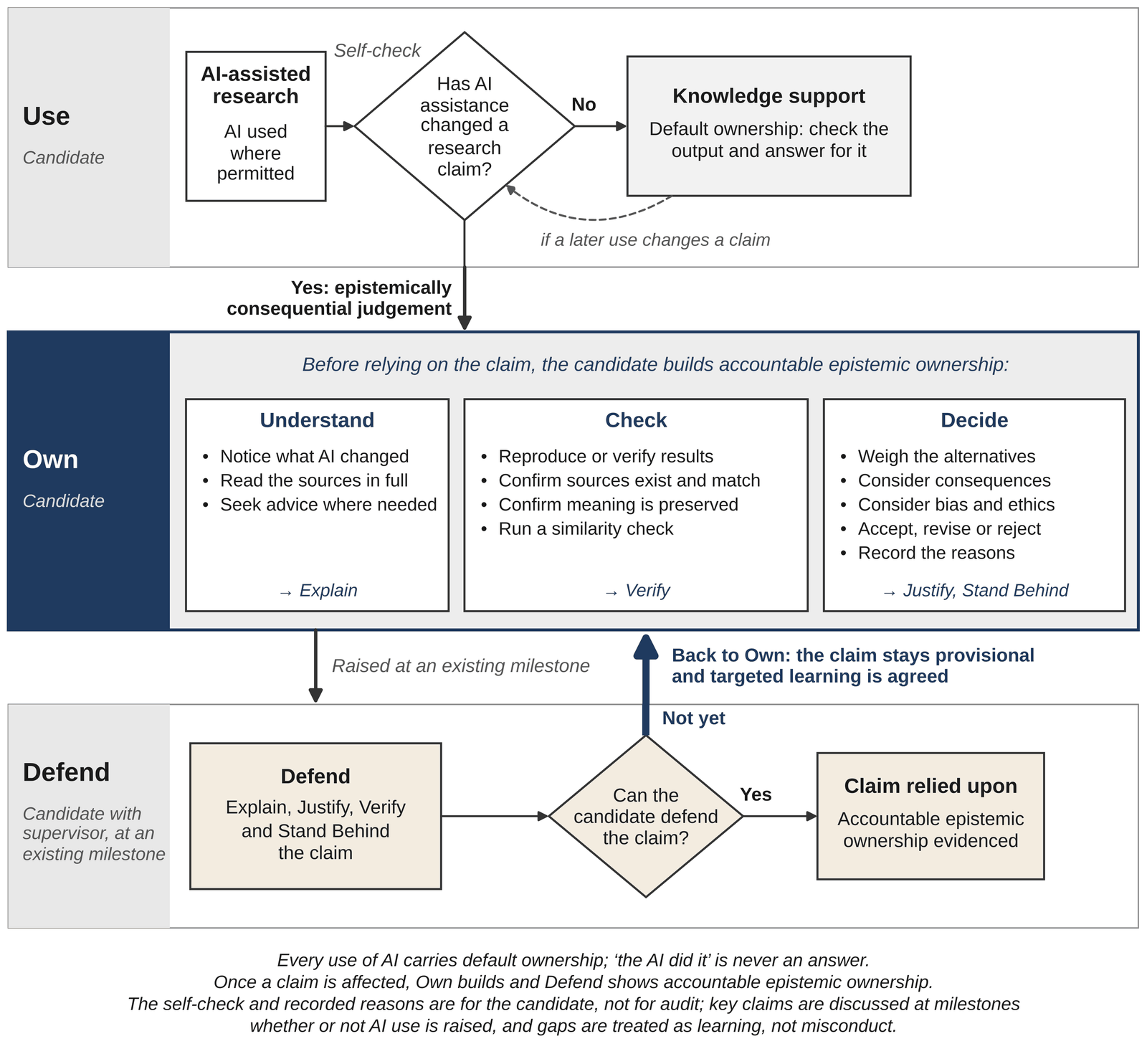
You are responsible for all of your work, whatever tools helped you. Most of the time AI simply helps with the work: finding papers, tidying your writing, fixing code. Sometimes it changes what your research claims. This guide is organised around that difference, in three stages.
UseYou · every AI-assisted task
Use AI where it is permitted. Check what it gives you and be ready to answer for it. “The AI did it” is never an answer.
OwnYou · when AI has changed a claim
Before you rely on a claim that AI has changed, make it your own. Understand what changed and read the sources. Check that results, sources and meaning hold. Weigh the alternatives, consequences, bias and ethics, then accept, revise or reject the claim.
DefendYou with your supervisor · at a milestone you already have
Explain, justify, verify and stand behind your key claims in a conversation at a progress review, confirmation of candidature or research-group presentation.
Show the full Use, Own, Defend diagramSAGE-R in three stages: Use, Own, Defend.
Use: before you start
If you use AI, you remain responsible and must stand behind the research.AI may help produce the work. Only you can defend it.
Before putting research material into an AI tool, check that the use is allowed and that the material is safe to share.
01
Check your university’s rules
SAGE-R does not itself authorise AI use. Check applicable University policies, ethics approvals, data-management and privacy requirements, intellectual-property arrangements, funder and publisher conditions, disciplinary standards and supervisory guidance. Use only approved tools and data-handling arrangements where required.
02
Protect people and research
Do not enter identifiable participant information, confidential datasets, culturally restricted information, commercially sensitive material, unpublished intellectual property, ethics documents or third-party content unless the tool and proposed data handling are expressly approved. De-identification alone may not be enough where agreements, Indigenous data sovereignty, contractual restrictions or re-identification risks apply.
Then apply these six actions whenever AI assists your research. Actions 1 to 3 are part of Use, actions 4 and 5 are part of Own, and action 6 is Defend.
01
Check permission Use
Is this use permitted by your institution, ethics approval, funder or publisher?
02
Protect the research Use
Keep confidential data and unpublished work out of unapproved tools.
03
Set the boundary Use
Decide what AI may help with and what judgement stays yours.
04
Verify independently Own
Check against original sources, data, code, methods or other evidence.
05
Record and disclose Own
Follow the record-keeping and disclosure requirements that apply to your research.
06
Defend the work Defend
Explain, justify, verify and stand behind your decisions and claims.
You own the researchDecisions · Evidence · Claims
At the centre of the cycle: you own the research, including its decisions, evidence and claims.
If you cannot yet explain, justify, verify and stand behind a claim, it is not yet ready to enter the research.
One-page candidate reminder
Your self-check
Has AI changed a claim in my research?
Ask this whenever AI has helped, and ask it again if a later use changes a claim. Three questions help you answer it.
ContributionCould the AI assistance have altered what my research contributes?
ConsequenceIf AI got this wrong and I did not notice, would it change my findings?
Independent verificationCan I check this output myself, without relying on the AI tool?
If the answer is no, you carry on with ordinary care: check the output and answer for it. If the answer is yes, or you are unsure, the claim moves to Own. Your supervisor will model this self-check with you early in candidature.
Own: when AI changes a claim
When AI has changed a claim, the claim is not yet yours to rely on. Before you use it in a milestone document, a paper or your thesis, you do three things.
Understand
Notice what AI changed.
Read the sources in full.
Seek advice from your supervisor or a specialist where needed.
Prepares you to Explain
Check
Reproduce or verify the results.
Confirm that sources exist and say what you report.
Confirm that meaning has been preserved.
Run a similarity check.
Prepares you to Verify
Decide
Weigh the alternatives.
Consider consequences, bias and ethics.
Accept, revise or reject the claim.
Record your reasons.
Prepares you to Justify and Stand Behind
The reasons you record are for you. They help you recall why a decision was made when you are asked about it months later. They are not an audit trail, and they are not submitted as a form. The similarity check looks for unattributed overlap with existing sources, as it always has. It is not an AI detector, and SAGE-R does not rely on AI detection.
The worked examples below show Own in practice for the main research tasks. The minimum checks in each example are the Check part of Own for that kind of task.
Part2
Worked examples
Seven common research tasks, each showing where AI can help, where the ownership threshold falls and what Own involves. Each example ends with minimum checks and a Defend check.
A guide to practical uses
Where AI can assist across your research
Read across each row, then down. These stages follow the guidance below: AI may assist with defined tasks, while you remain responsible for the research decisions, evidence and claims.
01
Find and check literature
Locate relevant work and check AI summaries against the original sources.
Retain responsibility. Keep records and disclose use as required; be able to explain and defend your decisions and claims.
Spot-checking is a screen, not verification. A further AI response is not independent evidence. Check every material output you actually use against an original or authoritative source, dataset, method or appropriate independent test.
If an important output cannot be verified independently, do not rely on it until the issue is resolved with your supervisory team.
Worked example 1 of 7
Finding and checking literature
1
Finding and understanding literature
Using AI to find and summarise a research paper
Do not upload third-party papers or unpublished manuscripts unless the tool and proposed data handling have been expressly approved and content-sharing rights permit it. AI tools can help identify relevant papers and produce initial summaries of their content, saving considerable time in the early stages of a review. However, AI-generated summaries frequently contain errors. Incorrect sample sizes, misattributed findings, fabricated statistics and oversimplified interpretations are common. A summary you cannot verify is a liability, not an asset.
1
Use AI to produce an initial summary covering the research question, methodology, sample size, main findings, and stated limitations.
2
Verify every material claim that will inform the research. A three-item spot-check may be used as an initial reliability screen, but it does not replace direct reading and verification of the evidence ultimately relied upon.
3
If any detail is wrong, do not use the summary. Identify precisely what the AI misrepresented. Either read the relevant section and write your own notes, or, only where the tool and content-sharing arrangements are expressly approved, provide the relevant passage and request a correction based on that passage alone. Repeat the verification step.
4
The verified summary informs your own writing. It does not enter your thesis directly.
Minimum checks before relying on a paper or summary
Locate the paper in an authoritative database, publisher site or repository; confirm its authors, title, publication outlet, year and DOI or other identifier.
Read the original and check every material finding, method, sample detail, statistic and limitation you intend to use.
Check that AI has not merged papers, reversed a result, omitted a qualification or turned an association into a causal claim.
Defend check
Your supervisor may select any paper from your literature and ask you to describe its methodology and findings. If you can do this, including what the AI got wrong and how you corrected it, the process has worked as intended.
Worked example 2 of 7
Writing a literature review
2
Writing from the literature
Using AI to help write the literature review
AI may assist with the prose of a literature review, but only for sources you have already screened, read, and understood. The literature review must reflect your scholarly judgement about what is relevant, how sources relate to one another, and what the field has and has not established. That judgement is the intellectual contribution the section is required to demonstrate.
1
Screen and select your sources yourself. You decide what is included and why. AI may assist with database searches and initial filtering, but inclusion decisions are yours.
2
Read the papers you intend to include. Apply the source summarisation process above. You must be able to explain what each source contributes and why it belongs.
3
Prepare your own analytical notes identifying the themes, debates, gaps, and connections you intend to discuss. These are yours.
4
AI may help convert your notes into prose using the Boundary Prompt Mechanism in Example 3. The output must not introduce claims or connections beyond what your notes established.
Important
Your supervisor may select five references, often those that matter most to your argument, from your literature review and ask you to justify why each is included and what specific point it supports. If any reference was inserted by AI without your verification, this will be evident.
Minimum checks before using AI-assisted synthesis
Read and select the sources yourself; be able to explain why each one belongs.
Trace each substantive statement and comparison to the source that supports it.
Preserve disagreement, null findings, limitations and uncertainty; remove unsupported synthesis.
Defend check
Can you explain the thematic structure of your review, identify the key debates in the field, and justify the inclusion of any specific source in your own words, without reading from a draft?
Worked example 3 of 7
Writing from your reasoning
3
The Boundary Prompt Mechanism
Using AI to convert your dot points into research prose
Where AI-assisted drafting is permitted, the Boundary Prompt Mechanism provides a way to constrain assistance with writing sections of your thesis. A prompt does not guarantee compliance: you must verify the output and meet applicable disclosure requirements. Do not upload unpublished intellectual property or confidential notes without express approval of the tool and data handling. Your reasoning, evidence, and conclusions are established first, in your own notes, and AI is constrained to prose conversion only. The tool expresses your thinking; it does not generate new thinking.
1
Write your own dot points first. Include every claim you intend to make, the evidence that supports each one, the logical connections, and any qualifications. The depth of these notes determines the quality and accuracy of the output.
2
Construct a boundary prompt that explicitly instructs the tool not to add new claims, references, findings, or inferential steps beyond what you have provided.
3
Read the output closely. Check whether the AI has introduced additional claims, strengthened your qualifications, inserted new references, or drawn inferences you did not intend. These are common and must be removed.
4
Revise and own the final version. The text that enters your thesis must be one you fully endorse and can Defend.
Boundary Prompt Template
"Write the following section using only the points and evidence listed below. Do not add new claims, introduce additional references, draw conclusions beyond what the points establish, or strengthen any qualification I have expressed. Maintain the logical sequence as given. Use formal academic prose appropriate to a doctoral thesis."
[Your dot points here]
After receiving the output: highlight any sentence that introduces something not present in your dot points and remove or rewrite it.
Minimum checks before prose enters your thesis
Compare the output with your original notes and remove every claim, inference or reference your evidence did not establish.
Check quotations, statistics, terminology and citations against their original sources.
Confirm the final text preserves your qualifications and is reasoning you understand and endorse.
Defend check
Can you show your original dot points and demonstrate that the final prose did not extend beyond them? Can you explain every claim in the section and identify the evidence that supports it?
Worked example 4 of 7
Coding, methods and instruments
4
Discipline methods support
Using AI for coding, experiments, and discipline-specific methods
Research involves substantial technical execution tasks that are not in themselves knowledge contributions. Writing and debugging code, constructing simulation models, designing laboratory protocols, producing circuit diagrams, building survey instruments, generating patient assessment frameworks, and constructing financial models all involve labour that AI can assist with effectively. Such assistance may be appropriate where permitted by disciplinary and institutional requirements. Do not upload protected code, unpublished models, survey or interview instruments, participant information or confidential protocols unless the tool and proposed data handling have been expressly approved. The requirement is that you understand what the tool has produced and can explain and justify every methodological decision it embodies.
What AI assistance with methods looks like
A social science candidate uses AI to generate an interview guide from their research questions. An engineering candidate uses AI to debug a simulation script. A nursing candidate uses AI to structure a systematic review protocol. A business candidate uses AI to generate initial survey items from their theoretical framework.
What you must own
The methodological rationale: why this approach, why these questions, why this design. AI can produce an interview guide; it cannot decide whether semi-structured interviews are the appropriate method for your research question. That decision is entirely yours.
Minimum checks before using a method, model or instrument
Choose and justify the research method independently of the AI output.
Inspect and test code, formulas or models with known results, realistic cases and relevant boundary or error conditions.
Check versions, parameters, variable definitions and assumptions; confirm instruments align with your research questions and approvals.
Defend check
Your supervisor may ask what tools you used, how outputs were verified, and what the code or protocol does, why it is designed that way, and what would change if a specific design decision were altered.
Worked example 5 of 7
Analysis and interpretation
5
Analysis and findings
Using AI to assist with data analysis and results interpretation
Statistical and analytical software has been central to research for decades. Running a t-test, ANOVA, regression, or thematic coding procedure in SPSS, R, NVivo, or Python does not make analysis less rigorous; the tool applies established procedures to your data and you interpret the result. Where permitted, AI may assist with analytical work, but its outputs require careful verification. Do not upload confidential datasets or participant information unless the tool and proposed data handling have been expressly approved; de-identification alone may be insufficient.
The similarity to SPSS
Conventional statistical software generally executes a specified analytical procedure deterministically; the researcher remains responsible for data quality, test selection, assumptions, parameter settings and interpretation.
The critical difference
Generative AI may introduce errors, omit relevant patterns, apply silent assumptions, or produce plausible-sounding interpretations that are statistically or contextually wrong. You cannot trust a result because it looks reasonable. You must verify that it is correct.
1
You decide the analytical approach. The choice of test, coding strategy, or analytical framework is a methodological decision that must precede and remain independent of AI assistance.
2
Use AI to assist with execution: running the analysis, producing visualisations, organising output, and generating a first-pass interpretation.
3
Scrutinise the output for four specific risks: factual errors in the numbers; patterns that have been overlooked; assumptions about your data the tool applied without stating; and interpretations that reflect training data rather than your specific research context.
4
The interpretation and its justification are yours. AI may produce a plausible narrative of your results. You must determine whether that narrative is accurate and appropriate to your context before it enters your thesis.
Minimum checks before reporting an analysis
Confirm the correct dataset, variables, units, exclusions, missing-data treatment and transformations were used.
Reproduce or independently check the method, assumptions, formulas and numerical results.
Compare each table and figure with the data, including labels, axes, units, totals and uncertainty; trace qualitative themes to source material.
Defend check
In your progress meeting, your supervisor may ask you to walk through a specific finding: why you chose the analytical method, what the result shows, what alternative explanations exist, and what the result does not show.
Worked example 6 of 7
Discussion and implications
6
Discussion, implications, and recommendations
Using AI in the interpretive and contribution sections
These sections are where your original contribution is most visible. They require you to synthesise your findings with the existing literature, identify what your study adds to or challenges in the field, acknowledge limitations honestly, and draw conclusions proportionate to your evidence. AI may assist with drafting using the Boundary Prompt Mechanism, but four verification responsibilities apply here that do not apply to more procedural sections.
1
Verify against overgeneralisation. AI-generated discussion prose frequently overstates significance or suppresses qualifications. Check every claim against your actual results and ask whether the strength of the language is justified.
2
Check for cultural and contextual assumptions. AI tools may embed assumptions drawn from international contexts that do not reflect your study's setting. A healthcare recommendation grounded in US or European practice may not apply to the Australian or regional context your research addresses. Identify and correct these mismatches.
3
Confirm every implication is grounded in your study. AI may generate plausible implications relevant to your topic but not supported by your specific findings. Every recommendation must be traceable to a result or pattern in your data.
4
Apply your domain knowledge. Your understanding of the context in which the study was conducted, and your familiarity with the practical environment your recommendations address, are not things AI possesses. They are what make the discussion an original scholarly contribution.
Minimum checks before making claims or recommendations
Trace each conclusion and recommendation to a finding or defensible synthesis of evidence.
Separate observed results from interpretation, explanation and recommendation; ensure causal or general claims fit the study design.
Consider alternative explanations, contradictory evidence and limitations; verify claims of novelty against the research record.
Defend check
An examiner may challenge any recommendation by asking: what specific finding supports this, how does it fit the existing literature, and what are its limitations in your specific context?
Worked example 7 of 7
References and citations
7
Reference management
Using AI to manage and generate references
Reference management software such as Endnote, Zotero, and Mendeley has automated reference formatting and insertion for many years. AI assistance with reference management occupies the same functional category: it is a productivity tool that handles a mechanical task, and may be appropriate where permitted by applicable requirements. Formatting references manually is not a research skill. Verifying that references are accurate is.
AI carries one additional and significant risk that reference management software does not: it will generate plausible-looking but entirely fabricated references. A paper with a convincing title, plausible authors, and a real journal name may simply not exist. Verification in this area is absolute.
1
Where permitted, use AI or reference software for formatting, organising, and inserting references. Use tools and data-handling arrangements approved for the material involved.
2
Verify bibliographic details using an authoritative database and confirm the cited claim against the original publication. Discovery tools can help locate a source; they do not replace reading it.
3
Never cite a source you cannot locate. If the paper does not appear in a reputable database, the reference must be removed regardless of how plausible it appears.
Note for supervisors
AI may assist in organising a reference-checking workflow, but existence and bibliographic accuracy must be confirmed through authoritative databases and the original publication.
Minimum checks before retaining a reference
Confirm the source exists and verify its authors, exact title, journal or publisher, year and DOI or other identifier.
Read the source and confirm it supports the particular claim; check quotations and numbers against their exact location.
Check for relevant corrections, retractions or superseding versions. Remove any source you cannot locate or that does not support the claim.
Defend check
Your supervisor or examiner may select any reference and ask you to locate the source and confirm the accuracy of your citation. If every reference has been verified, this presents no difficulty.
Applies to every task
Ethics and disclosure
AI assistance with the structure or language of an ethics application may be appropriate where permitted. Every ethical judgement, including risks, mitigation, consent and the participant experience, must remain yours.
Keep protected material out of unapproved tools
Do not upload ethics documentation, participant information, survey or interview instruments, confidential protocols or unpublished intellectual property unless the tool and proposed data handling have been expressly approved.
Follow the disclosure and record-retention requirements of your institution, ethics approval, project, funder and publisher. Your supervisor or examiner may ask which tools you used, what they contributed and how you verified the results.
Minimum checks for ethics and disclosure
Confirm the tool and proposed data handling are approved before entering research or participant material.
Verify legal, regulatory and professional requirements against current authoritative sources; make ethical judgements about risk, consent and mitigation yourself.
Discuss material changes to approved methods, instruments, data handling or participant risk with your supervisory team and ethics body before acting; record and disclose AI use as required.
Part3
Ready to Defend
How to prepare for the Defend conversation, with a quick reference to keep beside you.
Preparing to Defend
Defend is a conversation with your supervisor, or your supervisory panel, at a milestone you already have, such as a progress review, confirmation of candidature or a research-group presentation. It is not a separate examination. It concentrates on the claims that AI has changed, and your key claims are discussed whether or not AI was involved.
In the conversation you will be asked to Explain what you did and how AI contributed, Justify why your approach was appropriate, Verify the result with evidence beyond the AI tool, and Stand Behind the claim as your own. Be ready to do this using the sources and evidence you actually relied upon.
Explain the research problem and why it matters.
Justify your methodology and the alternatives you considered.
Locate the original evidence for every material claim.
Explain where AI assisted, what you checked and what you corrected.
Show the independent evidence used to verify important claims, sources and outputs.
Identify the limits of your findings and conclusions.
Explain how to reproduce or check the analysis or technical output without relying on the AI response.
Meet the applicable disclosure and research-information requirements.
Not yet is an outcome, not a failure. If you cannot yet defend a claim, it stays provisional while you go back to Own. You and your supervisor agree what you need to learn or check, and the claim is discussed again at a later meeting. Incomplete understanding on its own is a matter for learning, not misconduct.
Review and approve every element. Confirm dates, tasks, and details are accurate.
Source identification and summarisation
Potentially appropriate where permitted; verify material claims
Verify every material claim against the original publication. Share papers or manuscripts only with approved tools and data handling.
Literature review writing
Potentially appropriate where permitted; use Boundary Prompt
All sources selected and read by you. Analytical structure is yours. Verify no new claims were introduced.
Research writing (any section)
Potentially appropriate where permitted; use Boundary Prompt
Your dot points establish reasoning and evidence. AI converts to prose only. Every claim must trace to your notes.
Coding, protocols, instruments, models
Potentially appropriate where permitted; review outputs
You decide the methodological approach. Review all outputs for errors and unintended assumptions. Protect code, models, and survey or interview instruments with approved tools and data handling.
Data analysis and results
Potentially appropriate where permitted; scrutinise outputs
You choose the analytical method. Scrutinise output for errors, omissions, contextual assumptions, and overstatements. Protect datasets and participant information; de-identification alone may be insufficient.
Discussion, implications, recommendations
Potentially appropriate where permitted; apply the four discussion checks
Check for overgeneralisation, cultural assumptions, unsupported claims, and loss of domain-specific nuance.
Ethics application
Potentially appropriate where permitted; procedural elements only
Every ethical judgment must be yours. Procedural assistance requires permission. Protect ethics documentation and participant information; use expressly approved tools and data handling.
References and citations
Potentially appropriate where permitted; formatting only
Verify bibliographic details using an authoritative database and the cited claim against the original publication. Never cite a paper you cannot locate.