Guidance for higher degree research supervisors and graduate research coordinators on modelling the self-check, supporting Own and holding Defend at milestones that already exist.
Based on the SAGE-R framework (Elkhodr and Gide, 2026) · Updated November 2026 Dr Mahmoud Elkhodr & Professor Ergun Gide · CQUniversity Australia
Purpose and boundaries
SAGE-R helps supervisors establish, within ordinary supervision, that candidates understand, own and can defend the research claims that AI assistance has changed.
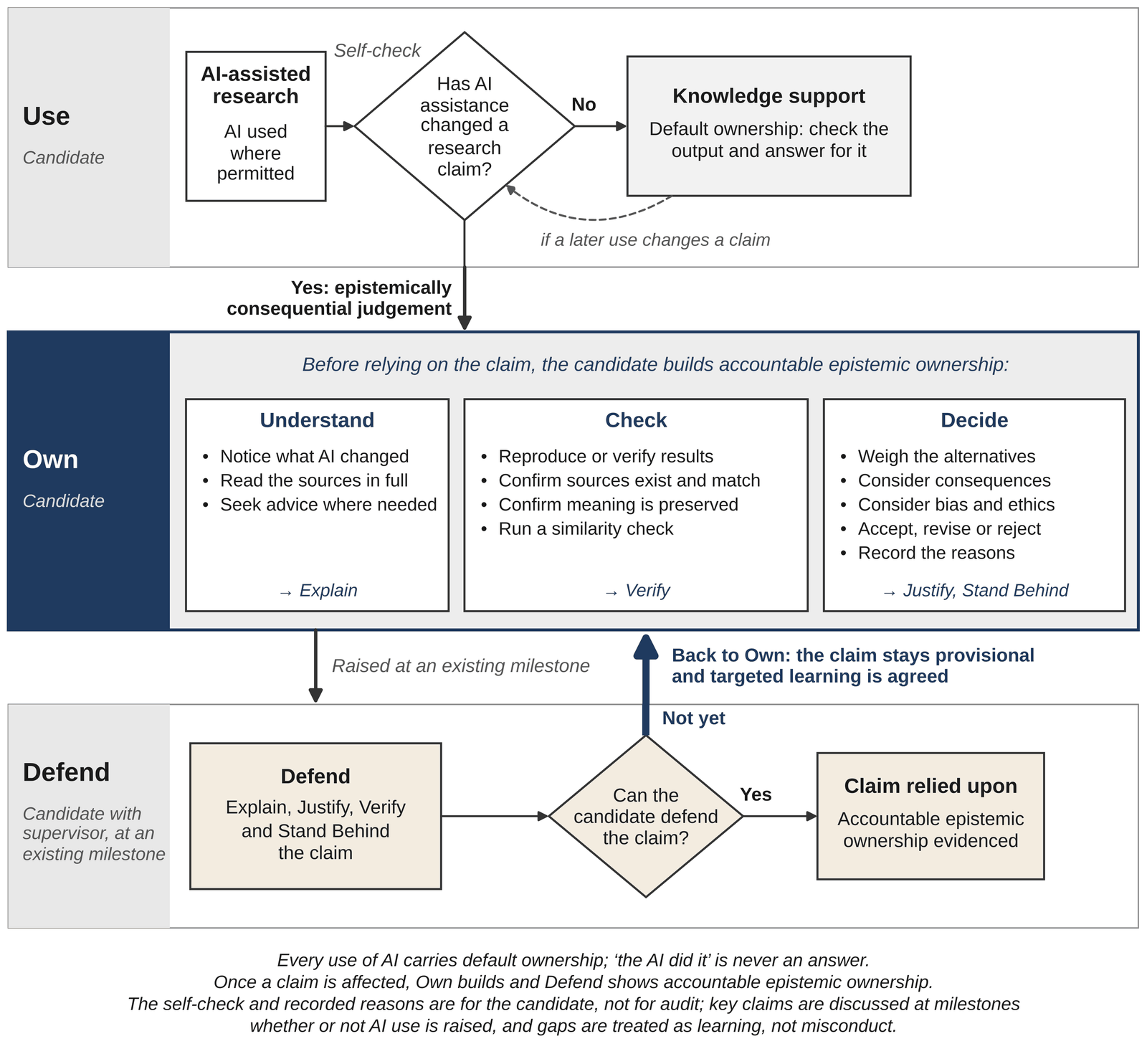
The framework is organised in three stages. Supervisors model the move from Use to Own early in candidature, support the candidate’s Own work, and hold Defend at milestones that already exist.
UseCandidate · every AI-assisted task
AI is used, where permitted, as knowledge support. Default ownership applies: the candidate checks the output and answers for it.
OwnCandidate · when a claim has changed
Before relying on a changed claim, the candidate makes it their own: what changed is understood, results, sources and meaning are checked, and alternatives, consequences, bias and ethics are weighed before the claim is accepted, revised or rejected.
DefendCandidate with supervisor · at an existing milestone
The candidate explains, justifies, verifies and stands behind the claim in a supervisory discussion.
Show the full Use, Own, Defend diagramSAGE-R in three stages: Use, Own, Defend.
Supporting open conversations about AI
Keep the focus on the research. SAGE-R works through the conversations you already have with candidates. Its aim is the candidate’s understanding of the research and the reasoning behind it, so the supervisory relationship is the main tool required. The approach relies on discussion rather than on prompt logs, chat histories or detection tools, and it works within existing forms and milestones.
Make openness about AI easy. Candidates are most likely to share how AI has been used when it is clear that doing so is welcome. Inviting that conversation early, and discussing key claims whether or not AI use is raised, keeps attention on the research rather than the tool and encourages transparency.
Treat gaps as learning. When a candidate cannot yet explain or verify a claim, the moment is best treated as an opportunity to learn. The claim is marked “not yet”, and the candidate is supported to return to Own: to read the sources, check the result and decide whether the claim should stand. Unresolved capability gaps are considered under existing progression processes, and evidence of a possible integrity breach under the appropriate integrity procedure; difficulty in learning does not by itself indicate misconduct. Required disclosure of AI use continues to apply.
Knowledge support and changed claims
Every use of AI carries default ownership: the candidate is responsible for all of the work, whatever assistance was used, and the fact that a tool produced an output is never an answer to a question about it. Most AI use is knowledge support, such as searching, organising information, formatting references or helping with code, which assists the work without changing a research claim.
Some uses go further. Where AI assistance shapes the research question, the evidence that counts, the method, the analysis and interpretation, or the extent of the contribution, it has entered epistemically consequential judgement, and the claim it affects needs more than default ownership before it is relied upon.
The supervisor’s role is to establish that the candidate has produced and owns the research contribution, rather than carrying AI-generated ideas or interpretations into the thesis. This is done within candidature milestones and supervisory discussions that are already in place, without adding a separate stage of assessment.
Model the self-check early
Has AI assistance changed a research claim?
ContributionCould the AI assistance have altered what this part of the research contributes?
ConsequenceWould an unnoticed error have material consequences for the findings?
Independent verificationCan the output be verified independently of the AI tool?
The self-check is the candidate’s, and the questions concern the claim, not the candidate. It is best modelled on real examples from the candidate’s own work in the first months of candidature, and it is revisited whenever a later use of AI changes a claim. Key claims are discussed at milestones whether or not AI use has been raised, so that supervision does not depend on disclosure and does not single out candidates who disclose.
How Defend works
Defend is a supervisory discussion held at a milestone that already exists, such as a progress review, confirmation of candidature or research-group presentation. It concentrates on claims that AI assistance has changed and is proportionate to their consequence. It can be a question in a meeting, a discussion of a draft, or a request to check a finding against its sources or data.
Dimension
What the candidate shows
An example prompt
Explain
Understands what was done, what AI contributed and what changed as a result.
“Walk me through how this result was produced, and where AI was involved.”
Justify
Gives reasons for the choices made, against credible alternatives.
“Why this method rather than the alternatives you considered?”
Verify
Substantiates the claim with evidence beyond the AI tool.
“Show me the source or data that supports this claim.”
Stand Behind
Accepts responsibility for the claim, its limits and its consequences.
“What are the limits of this claim, and are you prepared to put your name to it?”
The assurance question: Can the candidate explain the work, justify the decisions, verify the evidence independently and take responsibility for the claim?
Not yet. Where a claim cannot yet be defended, it stays provisional and the candidate returns to Own. Targeted learning is agreed, such as reading the original sources, reproducing an analysis or seeking specialist advice, and the claim is discussed again at a later meeting.
Most Defend discussions are formative and remain within ordinary supervision. Where a discussion contributes to a milestone decision, the candidate is told beforehand which claims will be discussed and how the discussion will be used, and the judgement is made by the authorised panel or decision-maker under local procedures, rather than by a single supervisor. An accessible equivalent, such as a written response or a recorded walkthrough, is offered where an oral discussion is not suitable.
Defend across the milestones
Assurance is planned from the start of candidature and distributed across milestones that already exist, so that ownership is supported as decisions are made rather than examined only at the thesis. The points below combine formal processes with ordinary supervisory activities. Their timing follows the applicable candidature and ethics requirements; they are not eight mandatory sequential milestones.
Prospective / pre-enrolment
1. Research proposal (pre-enrolment)
The applicant has not yet entered a supervisory relationship, so SAGE-R applies prospectively. Public guidance can inform applicants that a proposal must reflect their own research thinking. AI may help them understand how proposals are structured or what a research gap looks like, but the problem identified and the motivation expressed must be their own. A proposal substantially assembled by AI may lead to enrolment in a project the candidate does not intellectually own, which creates a capability problem from the first day of candidature.
Supervisor action
Use the first substantive meeting after enrolment for an early Defend discussion. Ask the candidate to state the research problem in their own words and explain why it was chosen. Introduce the self-check at the same meeting.
Supervisory activity
2. Foundation work (post-enrolment)
The intellectual work of this stage, namely narrowing the problem, formulating research questions, selecting a methodological approach and understanding ethical obligations, is foundational to the candidate’s capability. Defend is embedded in supervisory meetings, and the self-check is modelled on real examples from the candidate’s work.
Supervisor action
Ask the candidate to articulate the research questions in their own words, justify methodological choices using literature they have read directly, and explain the ethical considerations relevant to the study. When the development plan is agreed, note which existing milestones will include a Defend discussion.
Existing milestone preparation
3. Confirmation of candidature document
The confirmation document has two dimensions. The research questions, methodology, conceptual framework and expected outcomes are where the candidate’s ownership must be clearest, and every substantive claim should be one the candidate can defend in their own words. Budget, timeline, risk register, safety and procedural ethics elements are more administrative. AI assistance with these may be appropriate where permitted, provided the candidate understands and approves every element and uses approved tools for sensitive content.
Supervisor action
Before submission, hold a targeted Defend discussion: why these research questions, why this methodology, what the conceptual framework means and what the original contribution is expected to be. This accompanies supervisory feedback and editorial review rather than replacing them.
Existing milestone review
4. Confirmation of candidature review
Institutions review confirmation of candidature through a panel, independent reviewers or both. The review is already a milestone at which the candidate must account for the research, and it is a natural point for Defend. Where AI assistance has introduced claims or positions that the candidate cannot explain, the review is where the gap is most likely to surface.
Supervisor action
Before the document is submitted, check that the candidate can answer reviewer-level questions about every substantive element, including claims or positions shaped with AI. A claim that cannot yet be defended stays provisional and returns to Own before the review.
Where ethics approval is required
5. Ethics application
Ethics applications are procedurally dense and often poorly understood at the outset. AI assistance in understanding what a section asks, organising a response, or converting the candidate’s reasoning into institutional form may be appropriate where permitted. Ethics documentation, participant information and confidential project details are not uploaded unless the tool and proposed data handling have been expressly approved. The ethical reasoning itself, namely what risks exist, how they are mitigated, what participants will experience and why the design is ethically defensible, must be the candidate’s own.
Supervisor action
Before submission, ask the candidate to justify each substantive ethical position in their own words, including the risks identified, how they will be mitigated and what participants will experience.
Existing progress review
6. Progress reporting and review
Progress reports provide a longitudinal view of how the candidate’s scholarly understanding develops across candidature.
Supervisor action
Within the existing review, ask a few targeted questions about recent work: why a particular analytical decision was made, what a finding means, and how a changed claim was owned. Ask them whether or not AI use has been raised. Any notes follow current recordkeeping practice.
Supervisory assurance activity
7. Pre-submission readiness
A final readiness check helps establish that the thesis is understood and owned by the candidate before external examination, where supervisors cannot contextualise the candidate’s capability for examiners.
Supervisor action
Choose a purposeful sample of references, claims and analytical interpretations, weighted toward those of greatest consequence for the thesis. Ask the candidate to verify and justify them against the original source material or dataset.
Conversation prompts
Choose questions that fit the candidate’s discipline and current work, and ask the candidate to connect the explanation to an actual source, dataset or design decision.
Establish ownership
Why did you choose this research question?
What alternatives did you consider?
Which decisions were yours, and why?
Make verification visible
Show the evidence behind this claim.
What did the AI get wrong, and how did you notice?
What changes if this assumption fails?
Example: discussing an AI-assisted analysis
“Walk me through why you selected this method. Show how you checked the output against your data. Which alternative explanation did you rule out, and what remains uncertain?”
The answer is used to identify understanding and any need for further verification or support. A polished answer alone is not a substitute for checking the evidence.
Defend with the supervisory panel
Within an existing review
8. Defend conversation with the supervisory panel
A structured Defend conversation, held orally or in an accessible equivalent, can be included in an existing supervisory-panel meeting or pre-submission review. SAGE-R does not require a separate meeting or checkpoint, and it does not impose a new provenance-record obligation. Any notes follow agreed institutional recordkeeping, access and retention arrangements.
Supervisor action
Where this is adopted locally, use the existing panel review to ask how AI contributed and what was verified, which intellectual decisions were the candidate’s own, and how the candidate would answer an examiner’s challenge about a claim or methodological choice. The candidate is told beforehand how the conversation will be used, and any judgement is made by the authorised panel or decision-maker under local procedures.
Records and disclosure
SAGE-R does not itself require prompt logs or additional declaration forms. Existing institutional, ethics, contractual, publisher or project-specific requirements may nevertheless require disclosure or the retention of appropriate records.
The reasons a candidate records during Own are kept for the candidate’s own scholarship, not for audit. Where appropriate, existing supervisory notes may record the outcome of a Defend discussion. Any additional recordkeeping, access and retention arrangements are agreed through institutional consultation.
Quick-reference checklist
Milestone
The Defend question
What it looks like in practice
1. Research proposal Prospective
Did the candidate arrive with a research problem they own?
First substantive meeting: the candidate explains the problem in their own words, and the self-check is introduced.
2. Foundation work Self-check modelled
Can the candidate articulate the research questions, methodology and ethical considerations in their own words?
Supervisory discussion on real examples from the candidate’s work; Defend milestones noted in the development plan.
3. Confirmation document Substantive ownership
Does the candidate own every substantive claim in the research sections?
Pre-submission Defend: why these questions, why this methodology, what the framework means, what the contribution is.
4. Confirmation of candidature review Existing milestone
Can the candidate defend the research decisions to reviewers who have not supervised the work?
Supervisor confirms readiness; any claim that cannot yet be defended returns to Own before the review.
5. Ethics application Integrity
Can the candidate justify every substantive ethical position?
Pre-submission check: risk, mitigation and consent design explained in the candidate’s own words.
6. Progress review Longitudinal
Has understanding grown, and have changed claims been owned?
Targeted questions on recent decisions and findings, asked whether or not AI use has been raised.
7. Pre-submission readiness Verification
Do the most consequential references, claims and analyses hold up?
Purposeful sampling by consequence; the candidate verifies each item against source material or data.
8. Defend with the supervisory panel Panel judgement
Can the candidate account for AI contributions, verification decisions and intellectual ownership across the thesis?
Within an existing panel review, held orally or in an accessible equivalent; the candidate is told beforehand, and the judgement is made by the authorised decision-maker.
Before formal adoption, institutional consultation is recommended on policy fit, supervisory workload, recordkeeping and how Defend fits within existing review processes.